

In the last lesson, you learned that being physically clean and being in the ritual state needed for Salah are not exactly the same thing.
Now we come to ghusl: a full ritual washing used in particular situations.
The beginner idea: wudu is the regular purification you will use often. Ghusl is a full-body purification required after certain events before you return to Salah.
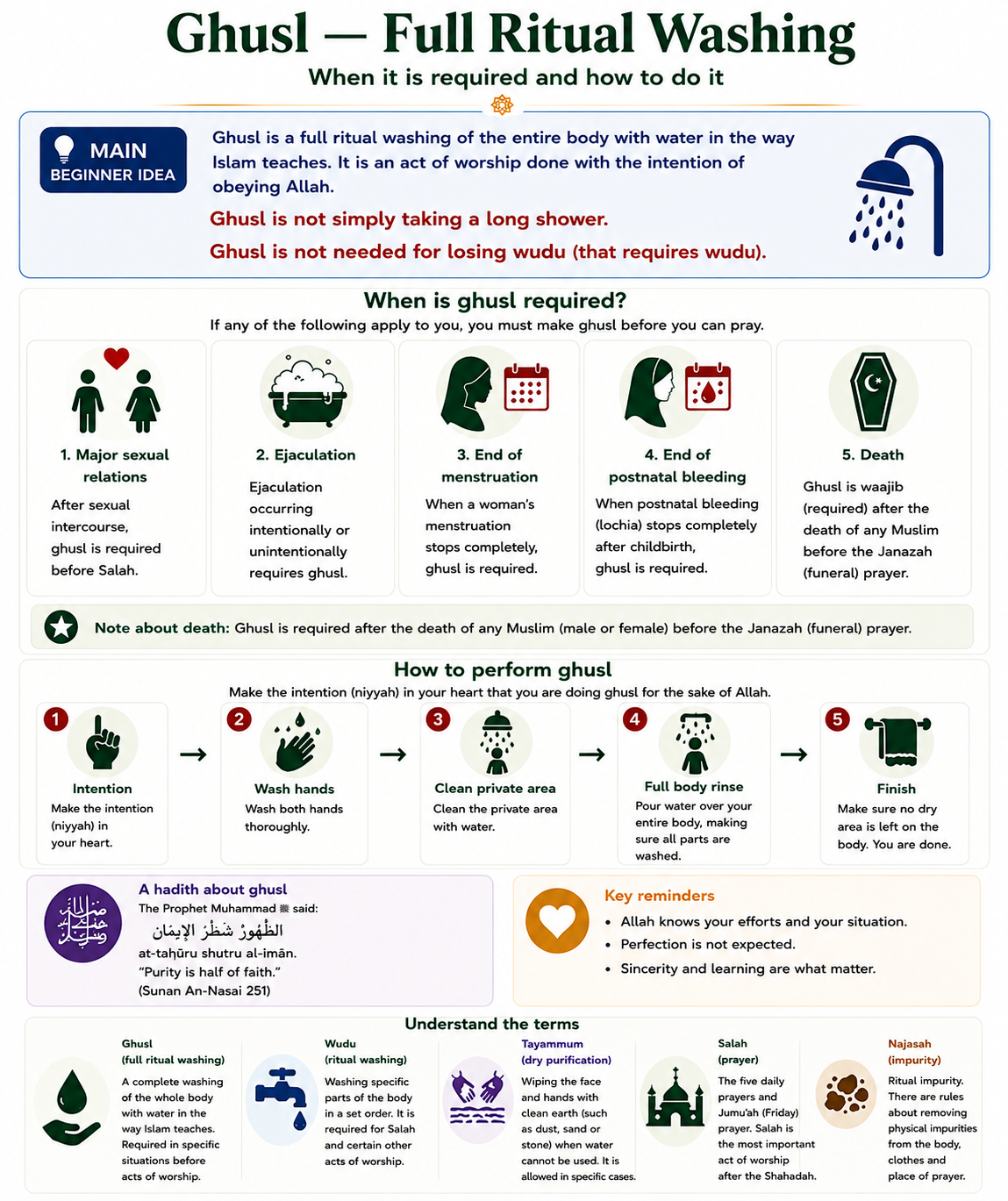
What is ghusl?
Ghusl means washing the whole body with the intention of ritual purification.
It is not simply “taking a shower because you are dirty.” You may already be physically clean. Ghusl is connected to a ritual state that must be lifted before certain acts of worship.
وَإِن كُنتُمْ جُنُبًۭا فَٱطَّهَّرُوا۟
Wa in kuntum junuban faṭṭahharū.
And if you are in a state of major ritual impurity, then purify yourselves.
When is ghusl required?
For a beginner, the most important situations to recognize are these:
- After sexual intercourse, even if there was no ejaculation.
- After ejaculation or sexual discharge that causes the state of janabah.
- After menstruation ends.
- After postnatal bleeding ends.
You may hear the Arabic word janabah. It refers to the major ritual state connected with sexual intercourse or ejaculation that requires ghusl.
Important for new Muslims: scholars differ about whether a person must perform ghusl simply because they have newly entered Islam, or whether it is strongly recommended unless another reason for ghusl is present. If you became Muslim without taking a ghusl, do not assume that your Islam was invalid. This point should be confirmed with a qualified scholar according to the guidance you follow.
For women: menstruation and postnatal bleeding
During menstruation, Salah is not performed. When the menstrual period has genuinely ended, ghusl is performed before Salah resumes.
The same basic principle applies after postnatal bleeding: when the bleeding has ended and the woman is ready to resume Salah, she performs ghusl.
You do not need to be embarrassed by these questions. Menstruation, childbirth and sexual purity are normal subjects in Islamic fiqh. Qualified teachers discuss them plainly because Muslims need to know how to worship correctly.
How do I know my period has ended?
This can be confusing for a new Muslim because bodies differ.
Women commonly recognize the end of menstruation by the return of their usual state of dryness or by the known sign of clear or white discharge that indicates the period has ended.
If you are unsure whether bleeding or coloured discharge is still part of your period, ask a qualified female teacher or scholar rather than repeatedly guessing. Detailed menstrual rulings can vary with circumstances and should not be reduced to one sentence on a beginner page.
What makes a ghusl valid?
At its simplest, ghusl requires that you intend ritual purification and that water reaches the entire body.
That means water needs to reach the skin and the roots of the hair, including places that are easy to miss.
Scholar-review note for this lesson: schools of Islamic law differ on some details of what is obligatory within ghusl, including the mouth and nose. The fuller method below includes them so the learner is not left with an incomplete practical routine.
A complete beginner-friendly way to make ghusl
This method follows the basic pattern reported from the ghusl of Prophet Muhammad ﷺ and gives you a clear sequence to follow.
- Make the intention in your heart. You are performing ghusl to become ritually pure.
- Wash your hands.
- Wash the private area and remove any physical impurity that needs to be cleaned.
- Make wudu as you would for Salah. If you have not learned wudu yet, do not panic — Lesson 14 will teach it step by step. You can use the simplified whole-body instructions below until you learn the fuller sequence.
- Rinse the mouth and nose.
- Wet the scalp and hair thoroughly. Work water through to the roots.
- Pour or run water over the entire body. Make sure it reaches everywhere.
- Check the easy-to-miss places: behind the ears, under the arms, inside the navel, between fingers and toes, skin folds, and anywhere water may not have reached.
Aishah رضي الله عنها reported that when the Prophet ﷺ performed ghusl from janabah, he washed his hands, made wudu, worked water through the roots of his hair, poured water over his head, and then washed his whole body.
Sahih al-Bukhari 248
If I have not learned wudu yet, can I still make ghusl?
Yes. Do not let the order of the lessons trap you.
If ghusl is required and you have not yet learned the full wudu routine, make the intention for ghusl and wash the entire body thoroughly, including the mouth and nose, making sure water reaches the scalp, hair and skin.
Then learn wudu as soon as you can. If you want extra certainty before Salah, you may make a fresh wudu after ghusl once you know how.
Do not delay learning Salah because the purification lessons feel technical. Learn the best practice you can, improve it as you learn, and ask a qualified teacher when you have a specific concern.
Does an ordinary shower count as ghusl?
A normal shower can serve as ghusl if you have the intention of ritual purification and you fulfil the requirements of ghusl.
A shower taken only for ordinary cleaning, without intending ghusl when ghusl was required, should not automatically be treated as ritual ghusl.
Do I need shampoo or soap?
No. Soap and shampoo are useful for physical cleanliness, but they are not what makes ghusl a ritual purification.
Water reaching the required parts of the body is what matters.
What about long hair or braids?
The important point is that water reaches the roots of the hair and the scalp.
There are detailed rulings about whether braided hair must be undone in different kinds of ghusl. A woman with braids, extensions or a hairstyle that makes water access difficult should ask a qualified teacher if she is unsure how the rule applies to her.
Do not simply wet the surface of the hair while leaving the scalp dry.
Anything that blocks water?
If something forms a waterproof barrier that prevents water from reaching the skin or nails, it may need to be removed before ghusl.
This is different from ordinary colour or staining that does not create a barrier.
Examples can become surprisingly detailed. Nail products, medical dressings, hair products and skin conditions can all raise different questions. When health or medical treatment is involved, do not remove something necessary for your safety just because you are worried about ghusl. Ask a qualified scholar how to purify in your situation.
Do I have to wash three times?
No. Do not turn ghusl into repeated washing because you are afraid once was not enough.
The Sunnah includes washing in a thorough and orderly way, and reports describe the Prophet ﷺ pouring water over his head three times. But the goal is not to repeat the entire shower three times.
Make sure water has actually reached the whole body, then move on.
Do I need a new wudu after ghusl?
You may hear different answers because this depends partly on how the ghusl was performed and on differences between schools of Islamic law.
If you made a complete ghusl that included wudu and did nothing afterward that would invalidate wudu according to the guidance you follow, many scholars do not require a second wudu.
For a beginner, there is nothing wrong with making a fresh wudu after ghusl if that helps you be confident before Salah. Once you have learned wudu in Lesson 14, this will be easy.
◇ Scholars differ
Ghusl after becoming Muslim: scholars differ over whether conversion itself makes ghusl obligatory or strongly recommended when no other cause of ghusl exists.
Mouth and nose: some schools treat rinsing the mouth and nose as obligatory parts of ghusl, while others do not. This lesson includes both.
Whether ghusl also covers wudu: the answer can depend on the type of ghusl, intention, what was included in it, and whether anything occurred during or after it that nullifies wudu according to the school being followed.
Touching the private parts: schools differ over whether direct touch invalidates wudu. This is one reason you may hear slightly different ghusl sequences from different teachers.
A simple visual checklist
Five words to recognize
- Ghusl — full ritual washing.
- Janabah — the major ritual state connected with sexual intercourse or ejaculation that requires ghusl.
- Wudu — the regular ritual purification used for Salah and certain other acts of worship.
- Menstruation — the monthly menstrual period; Salah resumes after it ends and ghusl is performed.
- Postnatal bleeding — bleeding after childbirth; detailed rulings should be learned with qualified guidance.
Your next step
You do not need to memorize every difference of opinion on this page.
Remember the practical core: when ghusl is required, intend purification and make sure water reaches the whole body, including the scalp and hair roots. Then continue learning the fuller Sunnah method step by step.
Next, we will learn the purification you will use far more often: wudu.
Continue to Lesson 14 — How to Make Wudu ↑