

You are about to begin learning Salah. Before Muslims pray, there is something important to understand first: purity.
This can be confusing when you are new because Islam speaks about more than one kind of cleanliness. Being physically clean and being in the ritual state needed for prayer are related ideas, but they are not the same thing.
The main idea: you can be freshly showered and still need wudu before Salah. And needing wudu does not mean that you are dirty.
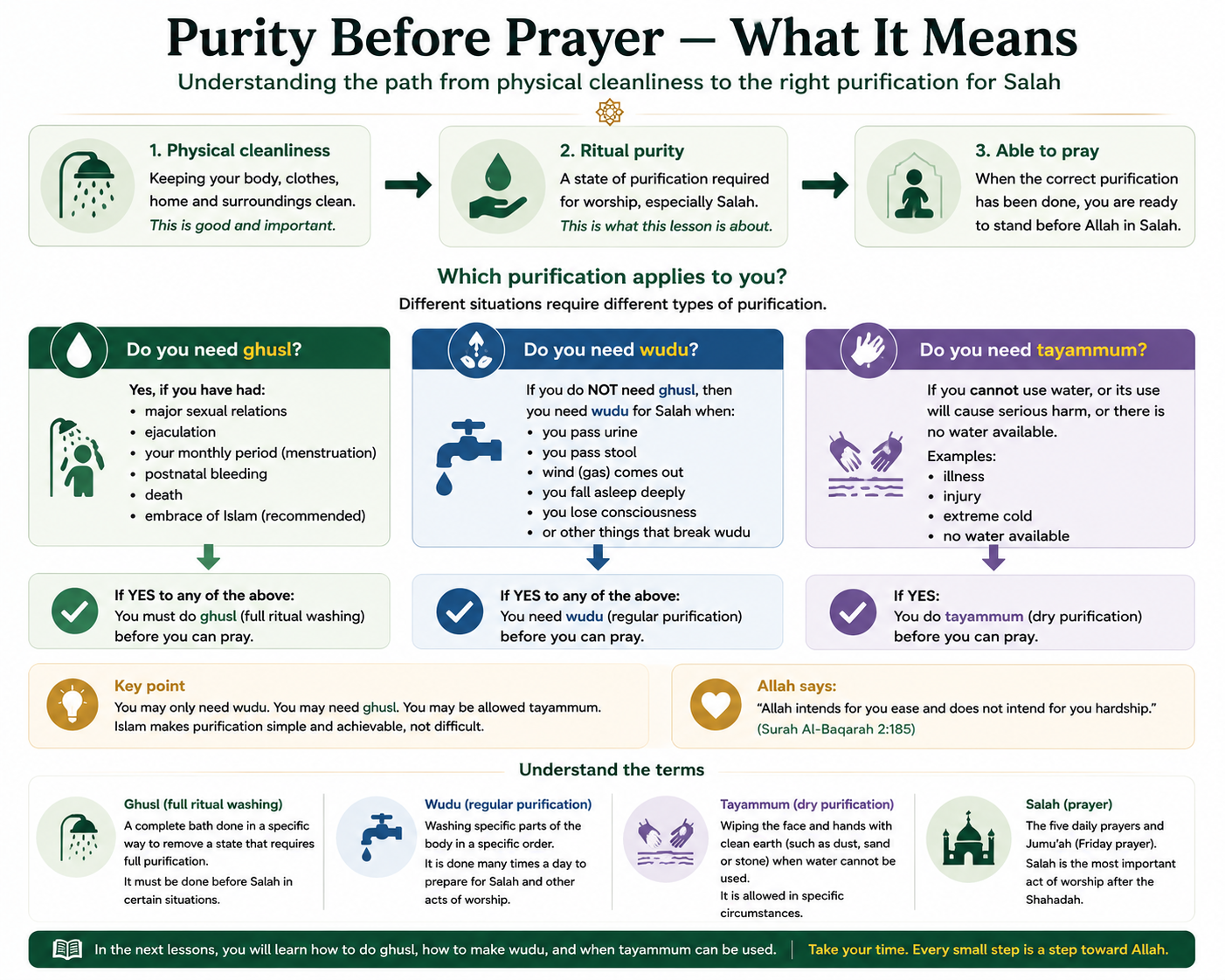
What does purity mean in Islam?
You may hear the Arabic word taharah, which means purity or purification.
For a beginner, it helps to separate two ideas:
You will gradually learn the rules connected with both.
Wudu is not simply washing because you are dirty
Wudu is a specific act of purification involving washing or wiping particular parts of the body in the way Islam teaches.
You might make wudu immediately after taking a shower. You might also still have wudu several hours after making it even though you have gone about your normal day.
So when a Muslim says, “I need wudu,” they are not saying, “I am physically dirty.” They mean they need to enter or renew the ritual state required for prayer.
This distinction matters: losing wudu is not a sin and does not make you morally impure. It simply means that before an act requiring wudu, you make wudu again.
Why do Muslims purify themselves before prayer?
Allah instructed believers to purify themselves for Salah.
يَـٰٓأَيُّهَا ٱلَّذِينَ ءَامَنُوٓا۟ إِذَا قُمْتُمْ إِلَى ٱلصَّلَوٰةِ فَٱغْسِلُوا۟ وُجُوهَكُمْ وَأَيْدِيَكُمْ إِلَى ٱلْمَرَافِقِ وَٱمْسَحُوا۟ بِرُءُوسِكُمْ وَأَرْجُلَكُمْ إِلَى ٱلْكَعْبَيْنِ
Yā ayyuhalladhīna āmanū idhā qumtum ilaṣ-ṣalāti faghsilū wujūhakum wa aydiyakum ilal-marāfiqi wamsaḥū biru'ūsikum wa arjulakum ilal-kaʿbayn.
O you who believe, when you rise for prayer, wash your faces and your hands up to the elbows, wipe your heads, and wash your feet to the ankles.
This verse also goes on to mention ghusl and purification when water cannot be used. You will learn those separately so that you do not have to absorb all the rules at once.
Three forms of purification you will learn
In this part of New To Islam, you will meet three important terms:
These are not three competing methods that you simply choose between. Each has circumstances in which it applies.
Why are we learning ghusl before wudu?
You may expect wudu to come first because you will use it regularly for prayer.
But there are situations in which ghusl is required before wudu alone would be sufficient for prayer. A new Muslim should know what those situations are before learning the ordinary wudu routine.
That is why the next lesson explains ghusl first. Then you will learn wudu step by step.
What about physical impurities?
Islam also has teachings about keeping the body, clothing and place of prayer free from certain physical impurities.
You may hear the Arabic word najasah for ritual or physical impurity.
You do not need a detailed list today. The beginner principle is simple: if you know that urine, feces or another recognized impurity is on your body, clothing or prayer area, it should be cleaned before Salah.
Do not turn purity into constant checking. Islam does not ask you to inspect yourself endlessly or assume that everything is impure. Learn the rules gradually and act on what you actually know.
After using the toilet
One practical part of purity is cleaning yourself after urinating or having a bowel movement. You may hear the Arabic word istinja for cleaning the private area after relieving yourself.
For a beginner, the main idea is straightforward: remove urine or feces from the body before Salah. Water is commonly used for this. Islamic law also discusses cleaning with suitable dry materials when the conditions for doing so are met, so do not assume that a particular bathroom setup is the only way a Muslim can become clean.
A simple bathroom routine: relieve yourself privately, clean the affected area properly, wash your hands, and then make wudu when you need wudu for Salah.
Take reasonable care when urinating so that urine does not unnecessarily splash onto your body or clothing. If you know urine has reached your body or clothing, clean the affected area.
The Prophet ﷺ passed by two graves and explained that one of the people was being punished in connection with failing to protect himself from urine.
Sahih al-Bukhari 216, 218
This teaching is one reason Muslims take cleanliness from urine seriously. It should make us responsible, not obsessive.
Clean what you know needs cleaning, then move on. Do not repeatedly inspect your clothing, imagine splashes you did not see, or keep washing because of ordinary doubt.
What about dog saliva?
Dogs are another situation where a new Muslim may hear different statements and become confused. Do not simply think, “A dog touched me, so everything is dirty.” Islamic law has specific rulings, and there are differences between recognized schools of Islamic law about dogs and impurity.
There is, however, a specific teaching from the Prophet ﷺ about a vessel that a dog has licked.
The Prophet ﷺ instructed that when a dog licks a vessel, it should be washed seven times, with one of the washings involving earth.
Sahih Muslim 279
Scholars differ over some details of how rulings concerning dogs and their saliva apply to clothing, the body, household items and different circumstances.
For a beginner: do not panic if a dog touches you, and do not assume everything the dog touches has become impure. If dog saliva gets directly onto your body, clothing or belongings, clean the affected area and ask a qualified teacher about any additional washing required according to the scholarly guidance you follow.
And remember the difference between impurity and wudu: getting a physical impurity on your body or clothing is not automatically the same thing as breaking your wudu. The impurity needs to be cleaned appropriately, while the rules about whether wudu remains valid are a separate question.
Personal cleanliness and the fitrah
Islam also teaches regular personal grooming. You may hear these practices described as part of the fitrah.
Among the practices a new Muslim should know are:
- Removing pubic hair.
- Removing underarm hair.
- Trimming the nails.
- For men, trimming the moustache.
Anas رضي الله عنه reported that a time limit was set for trimming the moustache, clipping the nails, removing underarm hair and removing pubic hair: these were not to be left for more than forty nights.
Sahih Muslim 258
Forty nights is a maximum limit, not a schedule telling you to wait forty days. These grooming practices can be attended to sooner as needed.
The hadith describes shaving the pubic hair and plucking the underarm hair, but a beginner should not assume that one particular modern grooming tool or hair-removal technique is the point of the teaching. The practical goal is to maintain these fitrah practices safely and regularly; detailed questions can be taken to a qualified teacher.
Pubic grooming is private personal care. Islam places importance on covering the private parts of the body and avoiding unnecessary exposure. You normally care for your own private area rather than exposing it to another person without a genuine need.
Eyebrows and facial hair for women
A new Muslim woman may also hear that Islam prohibits “plucking facial hair” and understandably wonder what that means.
There is a serious Prophetic warning concerning nams, commonly discussed in connection with plucking or shaping the eyebrows for beautification.
The Prophet ﷺ gave a serious warning concerning women who perform or seek nams for beautification.
Sahih al-Bukhari 5931; Sahih Muslim 2125
This does not mean that every noticeable facial hair on a woman must automatically be left untouched. Scholars have discussed a distinction between altering the eyebrows for beautification and removing noticeable or unusual facial hair, such as moustache- or beard-like growth on a woman.
◇ Scholars differ / details matter
Scholars have discussed the precise meaning and boundaries of nams, including which hairs are included, hair between the eyebrows, stray hairs and circumstances involving unusual facial-hair growth. Because these details can differ according to scholarly interpretation, a beginner should avoid assuming that every form of facial-hair removal has exactly the same ruling.
For a new Muslim woman: do not feel that Islam necessarily requires you to keep noticeable moustache- or beard-like facial hair. At the same time, do not substantially reshape or remove eyebrow hair simply because ordinary beauty grooming treats it as routine. Ask a qualified female teacher or scholar about the particular grooming you are considering.
These grooming practices are important, but they are not the same thing as wudu or ghusl. For example, needing to trim your nails or remove body hair does not by itself mean that your wudu has ended.
What if I am unsure whether I still have wudu?
This is another place where beginners can become anxious.
Islam does not teach you to rebuild your worship around every doubt. A well-known principle is that certainty is not removed by mere doubt.
For example, if you know you made wudu and later simply wonder, “Maybe I lost it?” without knowing that anything happened to break it, do not treat the doubt alone as certainty that your wudu is gone.
The Prophet ﷺ taught that a person who is uncertain should not leave the prayer merely because of doubt, unless there is a clear reason to know that wudu was broken.
Sahih al-Bukhari 137; Sahih Muslim 361
You will learn what actually breaks wudu in the wudu lesson.
Purity is preparation — not a barrier
When you first encounter rules about wudu, ghusl and impurities, it can feel as though there are many things that could make prayer “wrong.”
That is not the purpose of this part.
Purification prepares you to stand before Allah in Salah. You will learn it one piece at a time, just as Muslims before you learned.
If you make a beginner mistake because you genuinely did not know a rule: learn the correct practice when you discover it and ask a qualified scholar or trusted teacher if you need to know whether anything must be repeated. Do not let uncertainty stop you from learning to pray.
Seven words to recognize
- Taharah — purity or purification.
- Wudu — the regular ritual purification made for prayer and certain other acts of worship.
- Ghusl — full ritual washing required in certain situations.
- Tayammum — purification used in particular circumstances when water cannot be used.
- Najasah — physical or ritual impurity; you will learn the practical rules gradually.
- Istinja — cleaning the private area after urination or a bowel movement.
- Fitrah — the natural disposition; the Sunnah also uses this term for certain practices of personal cleanliness and grooming.
Your next step
For now, remember only this:
Clean does not automatically mean “I have wudu,” and needing wudu does not mean “I am dirty.”
Next, we will learn when a full ritual washing — ghusl — is needed and how to do it.
Continue to Lesson 13 — Ghusl — Full Ritual Washing ↑