

You have now learned what ritual purity means and when a full ghusl is needed.
Next comes the purification you will use much more often: wudu.
Do not worry about memorizing everything on your first try. Wudu becomes much easier once your hands have repeated the sequence a few times.
What is wudu?
Wudu is a specific ritual purification Muslims make with water for Salah and certain other acts of worship.
It is not the same as washing because you are physically dirty. You may be completely clean and still need wudu before prayer.
يَـٰٓأَيُّهَا ٱلَّذِينَ ءَامَنُوٓا۟ إِذَا قُمْتُمْ إِلَى ٱلصَّلَوٰةِ فَٱغْسِلُوا۟ وُجُوهَكُمْ وَأَيْدِيَكُمْ إِلَى ٱلْمَرَافِقِ وَٱمْسَحُوا۟ بِرُءُوسِكُمْ وَأَرْجُلَكُمْ إِلَى ٱلْكَعْبَيْنِ
Yā ayyuhalladhīna āmanū idhā qumtum ilaṣ-ṣalāti faghsilū wujūhakum wa aydiyakum ilal-marāfiqi wamsaḥū biru'ūsikum wa arjulakum ilal-kaʿbayn.
O you who believe, when you rise for prayer, wash your faces and your hands up to the elbows, wipe your heads, and wash your feet to the ankles.
Before you begin
Use clean water and make the intention in your heart that you are making wudu for purification.
You do not need to say a special sentence announcing your intention aloud.
Begin with Bismillah — “In the name of Allah.”
Remove anything that actually prevents water from reaching the skin or nails where washing is required. Ordinary colour or staining that does not form a waterproof barrier is different.
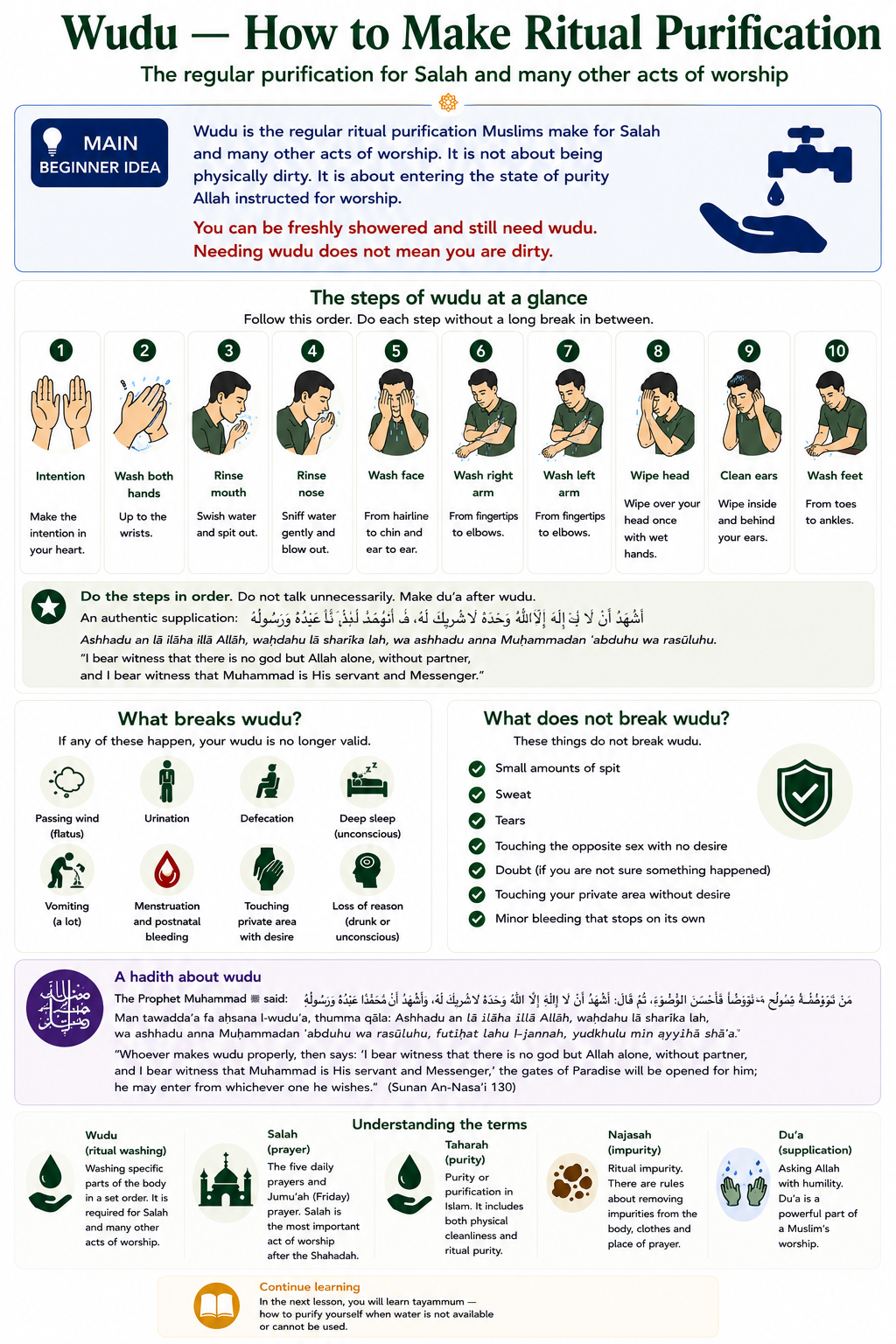
Wudu — step by step
Wash both hands to the wrists, including between the fingers. The Sunnah method is to wash them three times.
Take water into your mouth, move it around, and spit it out. The Sunnah method is three times.
Gently draw water into the nostrils and expel it. Do this in a way that is safe and comfortable. The Sunnah method is three times.
Wash the whole face — from the usual hairline to the chin, and from ear to ear. The Sunnah method is three times.
Wash the right arm, including the elbow, then the left arm, including the elbow. Make sure water reaches all around each arm. The Sunnah method is three times.
With wet hands, wipe over the head. Unlike the washed parts, the head is wiped, not washed repeatedly.
Using the moisture on your hands, wipe the ears as part of the head-wiping portion of wudu.
Wash the right foot, including the ankle, then the left. Make sure water reaches the heels and between the toes. The Sunnah method is three times.
The sequence at a glance
Do I really wash everything three times?
Three washes are part of the well-known Sunnah method for the washed parts of wudu, but do not turn the number three into repeated anxious washing.
Authentic reports also describe the Prophet ﷺ performing wudu washing parts once or twice. The important point is that the required area is actually washed.
The head is different: it is wiped rather than washed three times in the ordinary wudu sequence.
Uthman رضي الله عنه demonstrated the wudu of the Prophet ﷺ by washing the hands, rinsing the mouth and nose, washing the face and arms, wiping the head, and washing the feet.
Sahih al-Bukhari 159; Sahih Muslim 226
What breaks wudu?
You do not need a long legal list on your first day. Start with the situations you are most likely to encounter.
- Urination or defecation.
- Passing wind.
- Deep sleep or loss of awareness in circumstances where awareness is no longer maintained.
- Anything that puts you into a state requiring ghusl means ghusl is needed rather than simply making another ordinary wudu.
There are additional details and differences between schools of Islamic law about some other things that may invalidate wudu.
◇ Scholars differ
Touching a person of the opposite sex: schools differ over whether physical contact itself invalidates wudu and under what circumstances.
Touching the private parts: scholars differ over its effect on wudu.
Bleeding and vomiting: schools differ over whether and when these invalidate wudu.
Sleep: detailed rulings depend on the depth of sleep, awareness and position. The beginner principle is that deep sleep or loss of awareness requires renewed purification.
If someone tells you a different rule: do not assume one of you is inventing Islam. Some wudu details genuinely differ between recognized schools of Islamic law. Follow reliable qualified guidance rather than collecting random answers from many people.
What if I am not sure whether I broke my wudu?
If you know you made wudu and later only wonder whether you lost it, mere doubt does not automatically cancel what you knew with certainty.
The Prophet ﷺ taught a person who was uncertain whether something had happened during prayer not to leave merely because of doubt, but to rely on clear evidence.
Sahih al-Bukhari 137; Sahih Muslim 361
This principle is especially important if you are prone to repeating wudu because you are never sure it was “good enough.”
Make wudu carefully once, then move on. Islam does not ask you to keep starting over because of ordinary uncertainty.
What if I forget a step?
If you realize immediately that you missed an area that needed to be washed or wiped, correct it as soon as you notice.
Exactly what must be repeated can depend on what was missed, how much time passed, and the school of Islamic law being followed. If you discover after Salah that you definitely omitted an obligatory part of wudu, ask a qualified teacher what you should do.
Do not let fear of mistakes stop you from practising.
Do I need to make wudu for every prayer?
Not necessarily.
If you still have wudu when the next prayer time arrives, you can generally pray with that same wudu. You do not lose wudu simply because a new prayer time begins.
Many Muslims choose to renew wudu even when they still have it, but that is different from saying it is always required.
What if I cannot use water?
Islam does not require you to harm yourself in order to make wudu.
If water is genuinely unavailable, or using it would be harmful in circumstances recognized by Islamic law, there is another form of purification called tayammum.
That is Lesson 15.
What about socks?
You may see Muslims make wudu and wipe over certain footwear instead of removing it and washing their feet.
This practice has rules about the type of footwear, when it was put on, the person's state of purification and how long wiping remains permitted.
For your first wudu, keep it simple: wash your feet. We can teach wiping over qualifying footwear separately rather than making your first wudu lesson harder than it needs to be.
After wudu
There is a beautiful supplication taught after completing wudu. You do not need to memorize it before you can make a valid wudu.
أَشْهَدُ أَنْ لَا إِلٰهَ إِلَّا اللهُ وَحْدَهُ لَا شَرِيكَ لَهُ، وَأَشْهَدُ أَنَّ مُحَمَّدًا عَبْدُهُ وَرَسُولُهُ
Ashhadu an lā ilāha illā Allāhu waḥdahu lā sharīka lah, wa ashhadu anna Muḥammadan ʿabduhu wa rasūluh.
I testify that there is no deity worthy of worship except Allah alone, with no partner, and I testify that Muhammad is His servant and Messenger.
اللَّهُمَّ اجْعَلْنِي مِنَ التَّوَّابِينَ، وَاجْعَلْنِي مِنَ الْمُتَطَهِّرِينَ
Allāhumma-jʿalnī min at-tawwābīn, wajʿalnī min al-mutaṭahhirīn.
O Allah, make me among those who constantly repent, and make me among those who purify themselves.
Scholar-review note: The additional wording “Allāhumma-jʿalnī min at-tawwābīn, wajʿalnī min al-mutaṭahhirīn” is reported in Jamiʿ at-Tirmidhi 55. Hadith scholars have differed over the strength of this additional wording, so it is included here for scholar review rather than presented as an obligatory part of wudu.
The Prophet ﷺ taught this testimony after completing wudu and described a great reward for the one who says it.
Sahih Muslim 234
Eight words to remember
You do not need a paragraph. Just remember the order:
Hands → Mouth → Nose → Face → Arms → Head → Ears → Feet
Practise the sequence slowly. Soon you will stop needing to think about which part comes next.
Your next step
If you can, practise one complete wudu when you are not rushing to catch a prayer.
Keep this lesson open beside you and work through the steps.
Your first goal is not speed. Your goal is to learn where the water goes, what is washed, what is wiped, and the order of the routine.
Next, we will learn what to do when water cannot be used: tayammum.
Continue to Lesson 15 — Tayammum — When Water Cannot Be Used ↑