
In the last lesson, you learned that Allah sent Prophets and Messengers throughout human history.
Allah also gave revelation to guide people. Muslims therefore believe not only in the Qur'an, but in all the revelation Allah truly sent.
This is one of the Six Articles of Faith: belief in Allah's Books.
What is revelation?
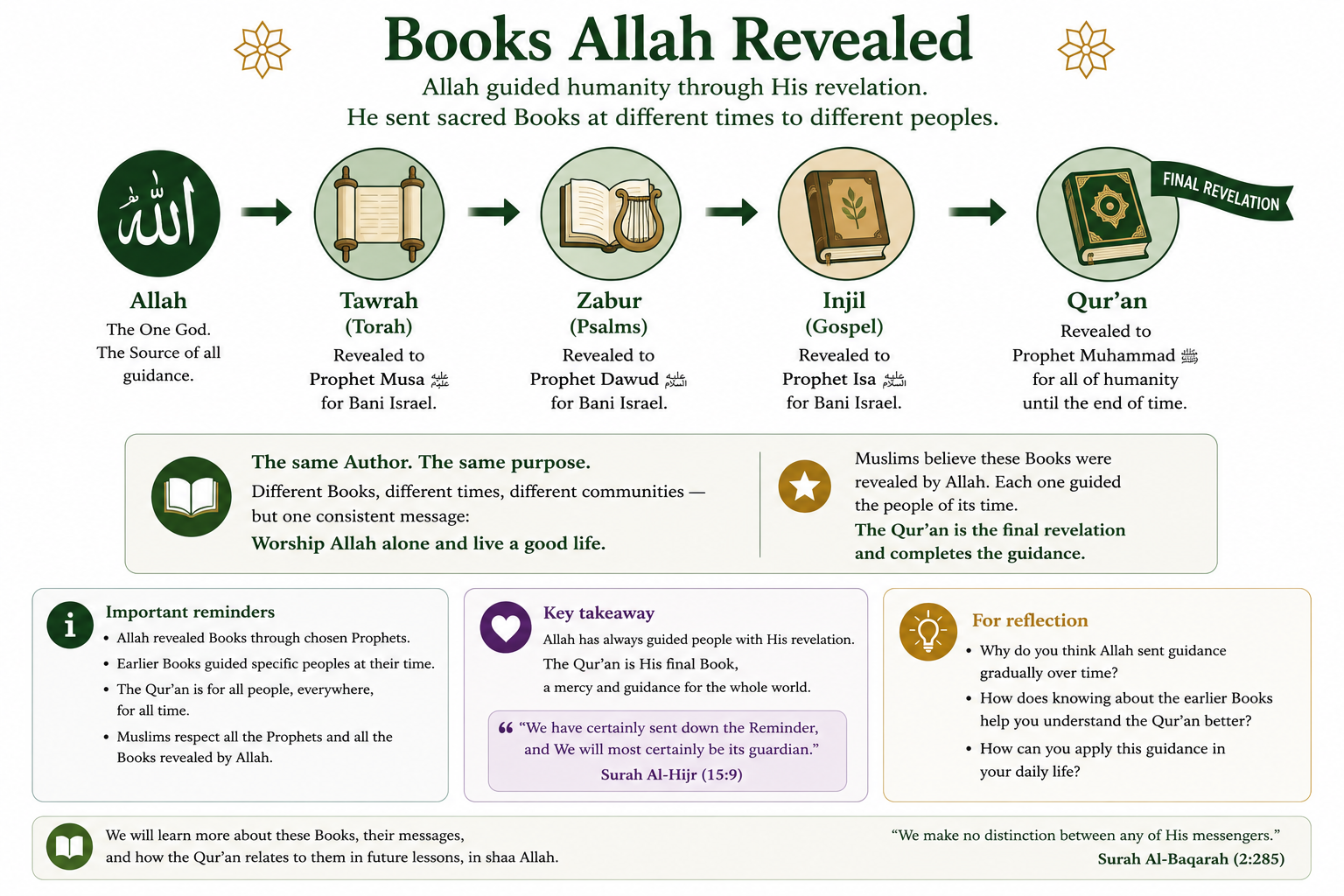
Revelation is guidance communicated by Allah to His Prophets and Messengers.
In Arabic, you will often hear the word wahy.
Human beings can think, observe and learn, but we cannot discover every truth about Allah, worship and the unseen by ourselves. Allah sent guidance.
Think of the pattern: Allah sends Messengers, and Allah gives revelation. The Messenger conveys what Allah has revealed.
The Qur'an was not the first revelation
New Muslims sometimes hear so much about the Qur'an that it can sound as though Allah had never revealed guidance before it.
Islam teaches otherwise.
نَزَّلَ عَلَيْكَ ٱلْكِتَـٰبَ بِٱلْحَقِّ مُصَدِّقًۭا لِّمَا بَيْنَ يَدَيْهِ وَأَنزَلَ ٱلتَّوْرَىٰةَ وَٱلْإِنجِيلَ
Nazzala ʿalaykal-kitāba bil-ḥaqqi muṣaddiqal-limā bayna yadayhi wa anzalat-Tawrāta wal-Injīl.
He has revealed to you the Book in truth, confirming what came before it, and He revealed the Torah and the Gospel.
The Qur'an speaks about earlier revelation with respect because its original source was Allah.
Four names you will hear often
Begin by recognizing these four:
The Qur'an also mentions scrolls or scriptures associated with Ibrahim (Abraham) عليه السلام and Musa عليه السلام.
صُحُفِ إِبْرَٰهِيمَ وَمُوسَىٰ
Ṣuḥufi Ibrāhīma wa Mūsā.
The scriptures of Abraham and Moses.
So do not memorize “Allah revealed only four Books.” The four names above are important revelations commonly taught to beginners, but the Qur'an itself tells us about other scriptures as well.
Is the Tawrah simply today's Old Testament?
Not exactly.
When Muslims say Tawrah, they are first referring to revelation Allah gave to Musa عليه السلام.
The collection Christians call the Old Testament contains many different books and types of writing. It should therefore not simply be treated as another name for the original Tawrah revealed to Musa عليه السلام.
There may be material in later scriptures that reflects or preserves elements of earlier revelation, but Muslims use the Qur'an and authentic Sunnah as the final authority for Islamic belief.
Is the Zabur simply today's Book of Psalms?
Muslims believe Allah gave the Zabur to Dawud عليه السلام.
It is common to see Zabur translated as “Psalms,” which can help a beginner recognize the connection. But it is safer not to assume without qualification that the original revelation given to Dawud عليه السلام is identical in every respect to a particular modern edition or collection called Psalms.
Is the Injil the New Testament?
No — not in the way Muslims use the word Injil.
Islam teaches that Allah gave the Injil to Isa (Jesus) عليه السلام.
The Christian New Testament is a collection of writings that includes the four canonical Gospels, Acts, letters and other texts. Muslims should therefore not use “Injil” as though it simply means the entire New Testament.
Likewise, the four Gospels are writings about Jesus عليه السلام and his message; they are not four separate books that Islam identifies as the original Injil revealed to him.
If you come from Christianity: this distinction can take time to absorb. You do not need to throw away every question you have or settle the entire history of the Bible today. Learn first what Islam means by Injil, then explore the larger questions carefully.
Does Islam say earlier scripture contains nothing true?
No. That is too simplistic.
The Qur'an confirms that Allah truly sent earlier revelation. At the same time, Muslims believe the Qur'an is the final revelation and the criterion by which religious claims are judged.
وَأَنزَلْنَآ إِلَيْكَ ٱلْكِتَـٰبَ بِٱلْحَقِّ مُصَدِّقًۭا لِّمَا بَيْنَ يَدَيْهِ مِنَ ٱلْكِتَـٰبِ وَمُهَيْمِنًا عَلَيْهِ
Wa anzalnā ilaykal-kitāba bil-ḥaqqi muṣaddiqal-limā bayna yadayhi minal-kitābi wa muhayminan ʿalayh.
We have revealed to you the Book in truth, confirming the scriptures that came before it and as a criterion over them.
For a beginner, the practical point is straightforward: your foundation for learning Islam is the Qur'an and the authentic teachings of Prophet Muhammad ﷺ.
What makes the Qur'an different for Muslims?
Muslims believe the Qur'an is Allah's final revealed Book, sent to Muhammad ﷺ.
Allah also promises its preservation:
إِنَّا نَحْنُ نَزَّلْنَا ٱلذِّكْرَ وَإِنَّا لَهُۥ لَحَـٰفِظُونَ
Innā Naḥnu nazzalnadh-dhikra wa innā lahu laḥāfiẓūn.
It is certainly We who have revealed the Reminder, and We will certainly preserve it.
The Qur'an was revealed in Arabic. Translations are enormously useful because they help people understand its meaning, but a translation is a human rendering of the Qur'an's meanings rather than a replacement for the Arabic Qur'an itself.
You will learn much more about this in Lesson 10 and later in the Beginning With the Qur'an section.
Do I need to read all the earlier scriptures now?
No.
A new Muslim does not need to begin by comparing hundreds of pages of different scriptures.
Your first responsibility is to build a sound foundation in Islam. Learn the Qur'an, learn the teachings of Prophet Muhammad ﷺ, and ask qualified teachers when questions about earlier scriptures arise.
If your previous faith background makes these questions especially important to you, they deserve their own careful study rather than rushed answers.
Five words to know
- Wahy — revelation.
- Tawrah — revelation given to Musa عليه السلام.
- Zabur — revelation given to Dawud عليه السلام.
- Injil — revelation given to Isa عليه السلام.
- Qur'an — the final revelation given to Muhammad ﷺ.
Your next step
Remember the main idea rather than trying to memorize every detail:
Allah has always guided humanity. He sent Messengers and revelation. Muslims believe in all revelation Allah truly sent, and the Qur'an is the final revelation and our authority for learning Islam today.
Now that you know where the Qur'an fits in the larger story, it is time to meet the man to whom it was revealed.
Continue to Lesson 9 — Meet Muhammad ﷺ ↑