
Islam did not begin with Prophet Muhammad ﷺ.
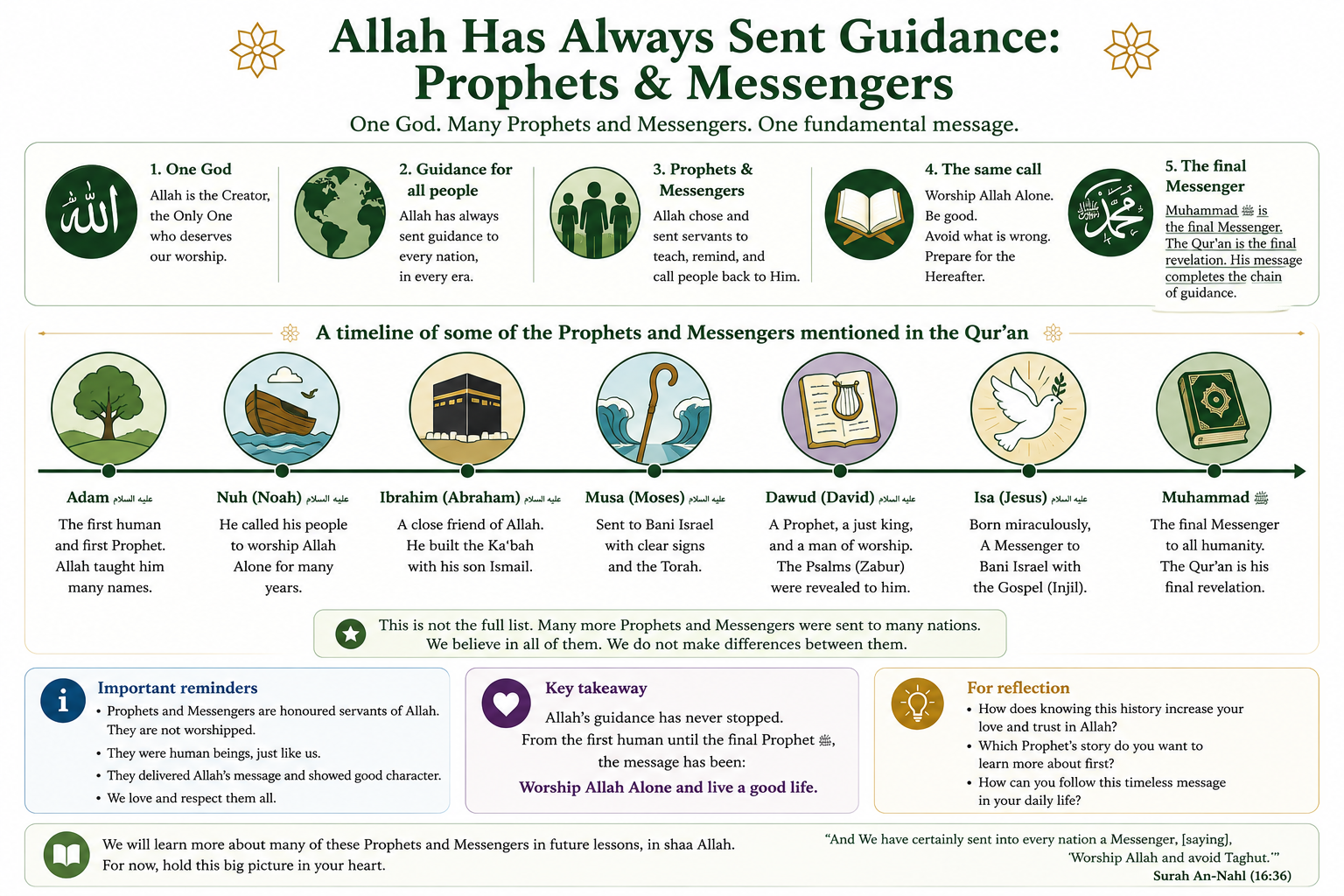
Muslims believe that Allah has guided humanity throughout history by sending Prophets and Messengers. Their languages, communities and circumstances differed, but the heart of their call was the same: worship Allah alone and follow the guidance He gives you.
This means that when you become Muslim, you are entering a story that reaches all the way back to Adam عليه السلام.
Allah did not leave humanity without guidance
Human beings need more than intelligence and instinct to know everything Allah wants from us. Allah sent revelation and chose people to convey His guidance.
وَلَقَدْ بَعَثْنَا فِى كُلِّ أُمَّةٍۢ رَّسُولًا أَنِ ٱعْبُدُوا۟ ٱللَّهَ وَٱجْتَنِبُوا۟ ٱلطَّـٰغُوتَ
Wa laqad baʿathnā fī kulli ummatir-rasūlan aniʿbudullāha wajtanibut-ṭāghūt.
We certainly sent into every community a messenger, saying: Worship Allah and avoid false gods.
The Prophets did not call people to worship themselves. They called people to Allah.
Prophet or Messenger — what is the difference?
You will hear two Arabic words:
- Nabi — Prophet.
- Rasul — Messenger.
Scholars have discussed the precise distinction between a Prophet and a Messenger in more detail than a beginner needs right now.
For this stage, the important point is simple: Allah chose human beings to receive and convey His guidance. Some are described in the Qur'an as Prophets, some as Messengers, and some with both descriptions.
You do not need to memorize a technical definition today. When a ruling or deeper theological distinction matters, learn it from a qualified teacher rather than building your understanding from short internet definitions.
Some names may already be familiar
If you came from a Jewish or Christian background — or simply grew up around Biblical stories — you may recognize many of the people named in the Qur'an.
These are only some of the Prophets. The Qur'an names others as well.
Were there Prophets we do not know by name?
Yes.
The Qur'an tells us that Allah related the stories of some Messengers to Prophet Muhammad ﷺ and did not relate the stories of others.
وَرُسُلًا قَدْ قَصَصْنَـٰهُمْ عَلَيْكَ مِن قَبْلُ وَرُسُلًا لَّمْ نَقْصُصْهُمْ عَلَيْكَ
Wa rusulan qad qaṣaṣnāhum ʿalayka min qablu wa rusulan lam naqṣuṣhum ʿalayk.
There are messengers whose stories We have told you before and others We have not told you.
So Muslims do not claim that the familiar names are the only people Allah ever sent.
One central call
The Prophets lived in different times and were sent to different peoples. Particular laws given to their communities could differ.
But their central call was consistent: worship Allah alone.
وَمَآ أَرْسَلْنَا مِن قَبْلِكَ مِن رَّسُولٍ إِلَّا نُوحِىٓ إِلَيْهِ أَنَّهُۥ لَآ إِلَـٰهَ إِلَّآ أَنَا۠ فَٱعْبُدُونِ
Wa mā arsalnā min qablika mir-rasūlin illā nūḥī ilayhi annahu lā ilāha illā Ana faʿbudūn.
We never sent a messenger before you without revealing to him: There is no deity except Me, so worship Me.
This is why Muslims see Islam as continuity in the worship of the One God, completed with the final Messenger and revelation — not as the invention of a new God.
Muslims believe in all of Allah's Messengers
Belief in the Messengers is one of the Six Articles of Faith.
A Muslim does not accept Muhammad ﷺ while deliberately rejecting Musa عليه السلام or Isa عليه السلام as Prophets of Allah.
لَا نُفَرِّقُ بَيْنَ أَحَدٍۢ مِّن رُّسُلِهِۦ
Lā nufarriqu bayna aḥadim mir-rusulih.
We make no distinction between any of His messengers.
This does not mean every Messenger had the same role, circumstances or rank. It means Muslims do not believe in some of Allah's Messengers while rejecting others whom Allah has affirmed.
What does Islam say about Jesus عليه السلام?
Muslims love and honour Isa — Jesus — عليه السلام.
Islam teaches that he was the Messiah and a Messenger of Allah, and the Qur'an speaks with great honour about him and his mother Maryam (Mary).
Muslims do not worship Jesus عليه السلام or regard him as Allah or the son of Allah.
If this is a major change from your previous beliefs: you do not have to settle every question on this page. Jesus عليه السلام deserves a careful explanation. New To Islam will provide separate background-specific learning for people coming from Christianity, including questions about Jesus, Mary, the Injil, the Trinity and the Bible.
Why Muhammad ﷺ?
Muslims believe Muhammad ﷺ is the final Prophet.
مَّا كَانَ مُحَمَّدٌ أَبَآ أَحَدٍۢ مِّن رِّجَالِكُمْ وَلَـٰكِن رَّسُولَ ٱللَّهِ وَخَاتَمَ ٱلنَّبِيِّـۧنَ
Mā kāna Muḥammadun abā aḥadim mir-rijālikum wa lākin rasūlallāhi wa khātaman-nabiyyīn.
Muhammad is not the father of any of your men, but he is the Messenger of Allah and the seal of the Prophets.
You do not need to know his whole biography yet. Lesson 9 will introduce you properly to Muhammad ﷺ, his life and his mission.
Why do Muslims say words after a Prophet's name?
You may have noticed something on this website:
Muhammad ﷺ — ṣallallāhu ʿalayhi wa sallam, asking Allah to send blessings and peace upon him.
Adam عليه السلام — ʿalayhi as-salām, “peace be upon him.” The same expression is used here for the other Prophets.
These are expressions of respect and prayer, not part of the Prophet's name and not an act of worship directed to the Prophet.
You will become familiar with them naturally. You do not need to be embarrassed if you forget them while you are learning.
Six words to know
- Nabi — Prophet.
- Rasul — Messenger.
- Wahy — revelation.
- Ummah — a community or people; the word is also commonly used for the worldwide Muslim community.
- Isa — the Arabic name for Jesus عليه السلام.
- Maryam — the Arabic name for Mary, the mother of Jesus عليه السلام.
Your next step
Do not try to memorize a long list of Prophets today.
Instead, remember the shape of the story:
Allah created humanity → Allah sent guidance → He sent Prophets and Messengers to different peoples → their central call was to worship Allah alone → Muhammad ﷺ is the final Prophet.
Next, we will look at another part of that same story: the Books and scriptures Allah revealed.
Continue to Lesson 8 — The Books Allah Revealed ↑