

During Ramadan, many masjids gather after the ‘Isha prayer for a special voluntary night prayer called Tarawih.
If this is your first Ramadan, you may see long rows of worshippers, hear much more Qur’an than you hear in the daily prayers, and notice that the prayer continues for several pairs of rak‘ahs. You do not need to know everything before you attend.
Your beginner instruction: pray ‘Isha, stay with the congregation for Tarawih, and follow the Imam. You do not need to know in advance how many rak‘ahs your masjid will pray.
Why Tarawih is worth making an effort for
Tarawih is voluntary, but the reward connected with standing in prayer during Ramadan is enormous.
Prophet Muhammad ﷺ taught that whoever stands in prayer during Ramadan with faith and seeking Allah's reward will have previous sins forgiven.
Sahih al-Bukhari 2008.
This does not mean you have to become an expert in night prayer overnight. Begin with sincerity, follow the Imam, and build what you can sustain.
What happens at Tarawih?
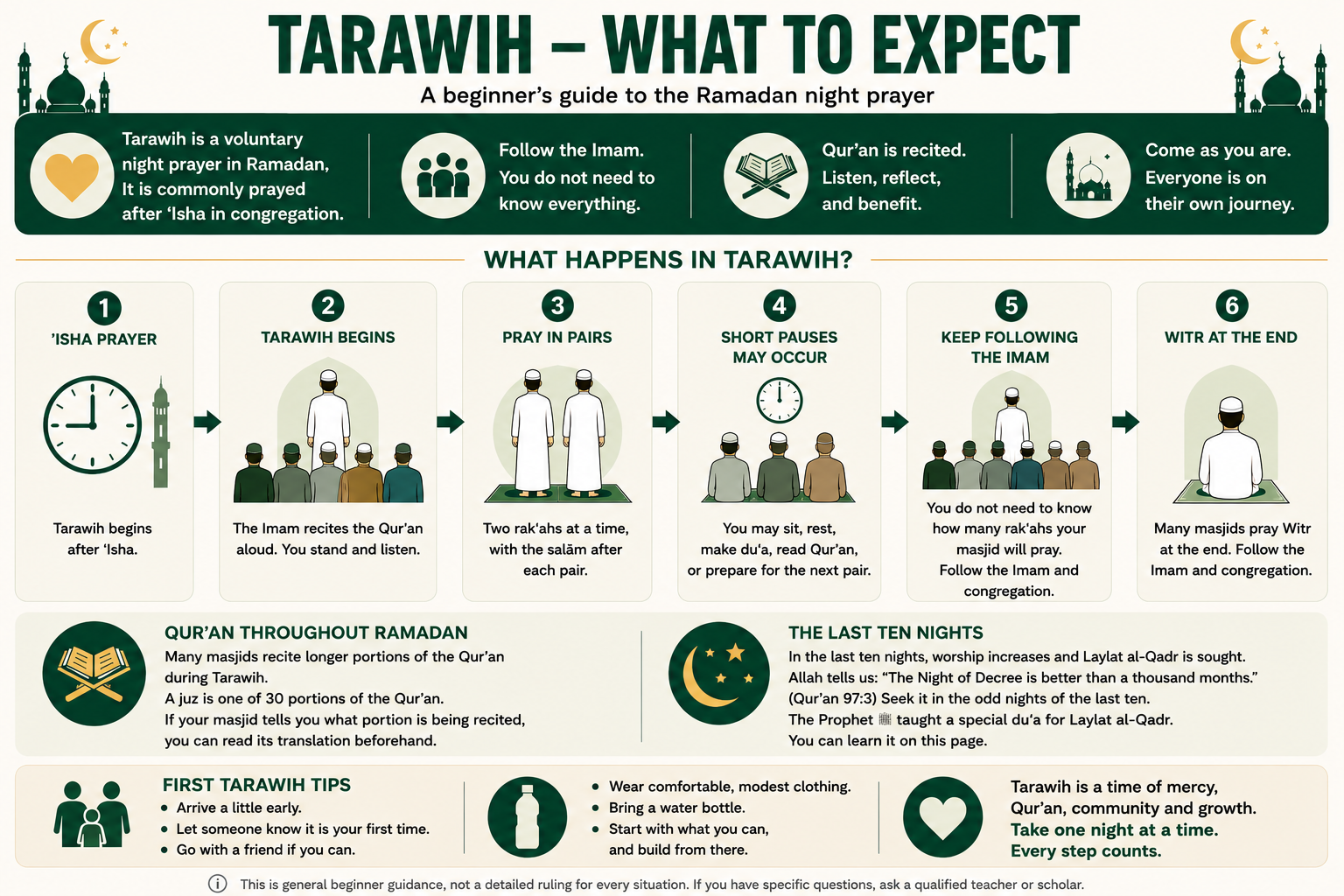
- Pray ‘Isha first. Tarawih is prayed after the obligatory ‘Isha prayer.
- Tarawih begins. The Imam recites Qur’an aloud while the congregation follows.
- The night prayer is prayed two rak‘ahs at a time. The salam is given after each pair.
- There may be pauses. Different masjids organise these differently.
- Keep following the Imam. You do not need to count the total number yourself.
- Many masjids pray Witr at the end. If your Imam leads Witr, follow the congregation. You can learn more on our Witr guide.
Stay with the Imam if you are able
A new Muslim may hear people debating whether a masjid prays eight, twenty or another established number of rak‘ahs. That debate does not need to become the focus of your first Tarawih.
There is, however, a beautiful reason to stay with the Imam until he finishes when you are able.
Prophet Muhammad ﷺ taught that when a person stands in prayer with the Imam until the Imam finishes, it is recorded for that person as though they prayed the whole night.
Jami‘ at-Tirmidhi 806 — graded Sahih.
So if you can remain until the Imam finishes, there is a special reward for doing so. This is much more useful for a beginner than choosing a rak‘ah number and leaving simply because that number has been reached.
At the same time, Tarawih is voluntary. If illness, disability, pregnancy, exhaustion, caregiving responsibilities, work or another genuine difficulty means you cannot remain, do not turn voluntary worship into despair. Do what you are able to do and keep returning to Allah.
Do I recite while the Imam is reciting?
Tarawih is an audible congregational prayer. You will hear the Imam reciting Qur’an aloud.
There are recognised fiqh differences concerning what a person praying behind the Imam recites during an audible congregational prayer. A beginner should not be dropped into that disagreement in the middle of their first Tarawih.
Use the congregational-prayer guidance you learned in Lesson 17 — How to Pray — Step by Step, and follow the Imam and your local congregation.
What if standing for a long time is difficult?
Tarawih can be physically tiring, especially when you are new to Salah. If you have a health or mobility limitation, do not assume that difficulty excludes you from worship.
Voluntary prayer has concessions for praying while seated, with details concerning ability and reward. If you need to sit because standing is difficult or unsafe for you, ask a knowledgeable local teacher how to apply those concessions in your situation.
And remember: the five obligatory prayers come first. Tarawih should help your Ramadan, not leave you so exhausted that you begin missing Fajr.
The Qur’an throughout Ramadan
Many masjids recite longer portions of the Qur’an during Tarawih. Some aim to complete the Qur’an during Ramadan; others follow a different schedule.
You may hear someone say, “Tonight we are on juz 12,” for example. A juz is one of 30 portions of the Qur’an.
A helpful beginner habit: if your masjid tells you which portion will be recited, read some of its English translation during the day. Then when you hear the Arabic at night, you may recognise the subject, story or message being recited.
You do not have to understand Arabic before you are welcome at Tarawih. Learning the meaning of the Qur’an is a journey, and listening attentively is part of becoming familiar with it.
The last ten nights
The final ten nights of Ramadan are especially precious. Prophet Muhammad ﷺ increased his worship during these nights, and Muslims seek Laylat al-Qadr — the Night of Decree.
لَيْلَةُ الْقَدْرِ خَيْرٌ مِنْ أَلْفِ شَهْرٍ
Laylatu-l-qadri khayrun min alfi shahr.
The Night of Decree is better than a thousand months.
Do not reduce that verse to a mathematical slogan. Allah Himself tells us the magnitude of this night: it is better than a thousand months.
The reward of standing on Laylat al-Qadr
There is another extraordinary promise specifically connected with worship on this night.
Prophet Muhammad ﷺ taught that whoever stands in prayer on Laylat al-Qadr with faith and seeking Allah's reward will have previous sins forgiven.
Sahih al-Bukhari 2014.
This is why Muslims make a special effort during the last ten nights. You may not know which night is Laylat al-Qadr, so do not feel that you must somehow identify it before worshipping.
Prophet Muhammad ﷺ instructed Muslims to seek Laylat al-Qadr in the odd nights of the last ten nights of Ramadan.
A du‘a to learn for Laylat al-Qadr
‘A’ishah رضي الله عنها asked Prophet Muhammad ﷺ what she should say if she knew which night was Laylat al-Qadr. He taught her:
اللَّهُمَّ إِنَّكَ عَفُوٌّ تُحِبُّ الْعَفْوَ فَاعْفُ عَنِّي
Allahumma innaka ‘afuwwun tuhibbul-‘afwa fa‘fu ‘anni.
O Allah, You are Pardoning and You love to pardon, so pardon me.
You do not have to wait for the last ten nights to begin learning it. Learn a little at a time so it is familiar when those nights arrive.
What is i‘tikaf?
During the last ten nights you may also hear about i‘tikaf, a devotional retreat in the masjid.
You do not need to undertake i‘tikaf in order to benefit from the last ten nights. For your first Ramadan, it is enough to understand what it is so you are not confused when you see people remaining at the masjid for extended periods.
Your first Tarawih — practical tips
- Arrive for ‘Isha. That lets you settle in before Tarawih begins.
- Ask where to pray if you are unsure. Masjid layouts differ.
- Wear clean, modest, comfortable clothing.
- Bring water if the masjid permits it. You can drink after the fast has ended.
- Tell someone it is your first Tarawih if that would help you. You can ask a trusted person where to stand and what normally happens at that masjid.
- Parents: check your masjid's arrangements rather than assuming childcare is available.
- Build gradually. You are learning a lifelong religion, not trying to prove everything in your first Ramadan.
If you are able, try staying until the Imam finishes. Not because you need to prove your endurance, but because Prophet Muhammad ﷺ taught us about the remarkable reward attached to remaining with the Imam until the prayer is completed.
Beginner summary
- Tarawih is a voluntary Ramadan night prayer.
- It is commonly prayed in congregation after ‘Isha.
- Night prayer is prayed two rak‘ahs at a time.
- Masjids may pray different numbers of rak‘ahs; you do not need to count them yourself.
- Follow the Imam and congregation.
- Many masjids pray Witr at the end.
- If you are able to remain with the Imam until he finishes, there is a specific hadith promising the reward of a whole night's prayer.
- Standing in Ramadan with faith and seeking Allah's reward is a means for previous sins to be forgiven.
- Laylat al-Qadr is better than a thousand months.
- Standing in prayer on Laylat al-Qadr with faith and seeking Allah's reward is a means for previous sins to be forgiven.
- Seek Laylat al-Qadr across the last ten nights, especially the odd nights.
- Learn the Laylat al-Qadr du‘a gradually.
- Protect your five obligatory prayers, especially Fajr.
- Confirm the final classification and terminology used for Tarawih and Ramadan qiyam.
- Confirm whether the page should name specific rak‘ah counts or remain count-neutral.
- Confirm the explanation of remaining with the Imam until he finishes and its application when a congregation has multiple prayer segments or Imams.
- Confirm the final recitation-behind-the-Imam wording and consistency with Lesson 17.
- Confirm the seated voluntary-prayer guidance and whether more detail is appropriate for beginners.
- Confirm the relationship between Tarawih and Witr and any madhhab-specific details that require a note.
- Confirm the Laylat al-Qadr du‘a Arabic/transliteration and whether the variant containing “Karim” should be mentioned or omitted.
- Confirm the wording about seeking Laylat al-Qadr in the odd nights of the last ten.
- Confirm whether additional i‘tikaf guidance belongs here or in a separate Ramadan resource.