

Core Lesson 22 — Learning the Arabic Script
Learning the Arabic Script
If the Arabic letters still look unfamiliar, that is completely normal.
You do not need to learn the Arabic language before you can begin learning to read its script. Those are two different projects.
For now, your goal is much smaller: begin recognising the letters, learn how they join, and connect the shapes you see with the sounds you hear.
Keep using transliteration while you need it. Transliteration can help you begin praying and learning short passages before you can read Arabic. As your reading improves, you can gradually depend on it less.
وَلَقَدْ يَسَّرْنَا ٱلْقُرْءَانَ لِلذِّكْرِ فَهَلْ مِن مُّدَّكِرٍ
Wa laqad yassarnal-Qur'āna lidh-dhikri fa-hal min muddakir.
And We have certainly made the Qur'an easy for remembrance, so is there any who will remember?
Learning to read Qur'anic Arabic takes practice, and people progress at different speeds. You do not need to race.
Why transliteration cannot do everything
Arabic contains sounds that English does not represent exactly. That means Roman letters can only approximate some Arabic sounds.
Transliteration is useful as a bridge, but eventually seeing the Arabic letters themselves gives you information that transliteration cannot always preserve.
This is not a reason to stop using transliteration today. Use the support you need while beginning the Arabic script alongside it.
What you are actually learning
Arabic has 28 basic letters. Learning to recognise those letters is only the first step. You will also learn how some of them connect and how vowel and recitation marks help you read Qur'anic words.
You are not being asked to understand Arabic grammar or vocabulary yet.
Think of this as learning how to decode the writing. Understanding the language can come later if you choose to study it.
Four things that may look unfamiliar at first
1. Arabic reads from right to left
Arabic words and sentences are read from right to left. After a little practice, your eyes begin to adjust to the direction naturally.
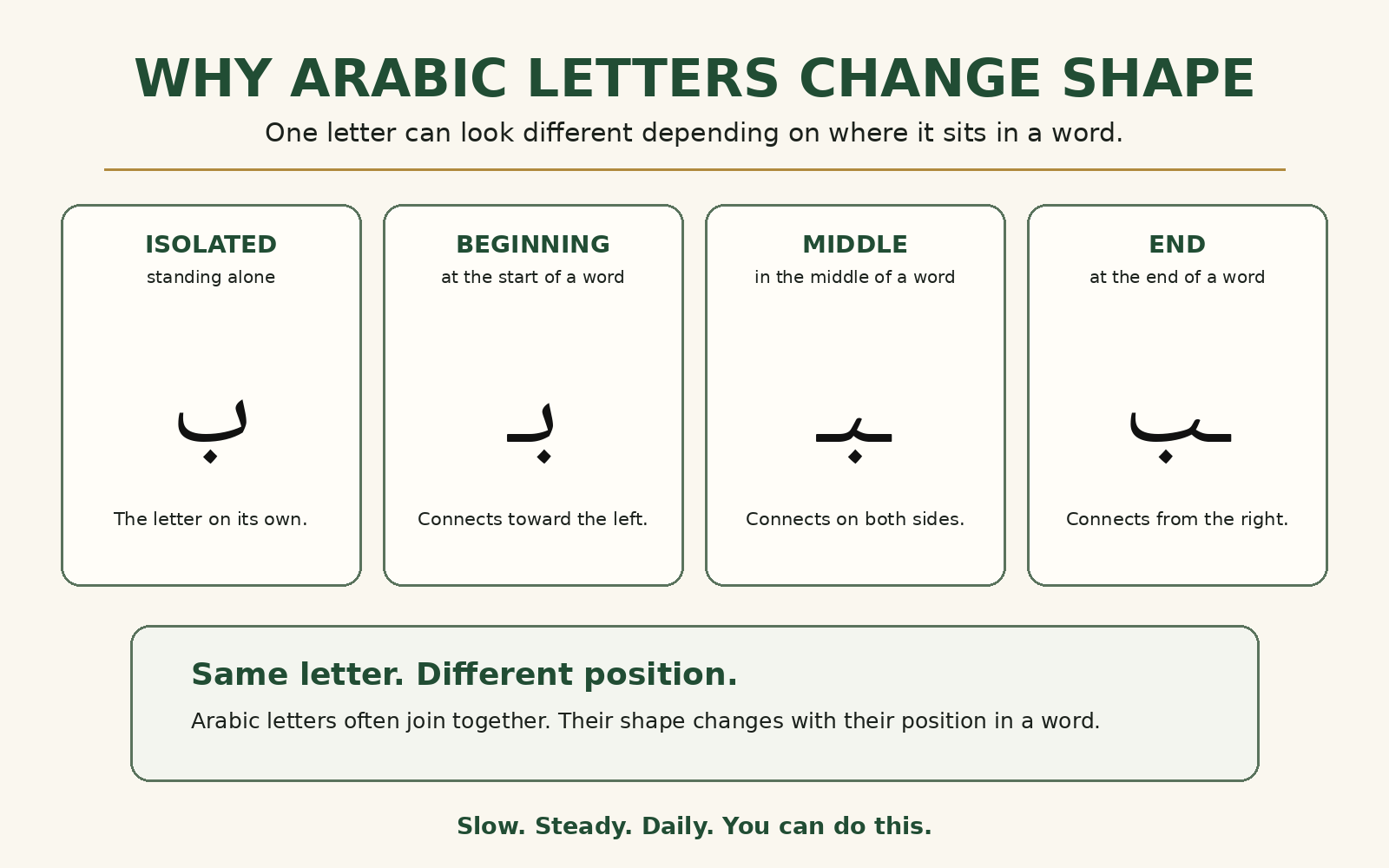
2. Many letters change shape when they join
Arabic letters often connect to the letters around them. A letter may therefore look slightly different when it stands alone, begins a word, sits in the middle, or appears at the end.
Not every Arabic letter connects in exactly the same way. For now, you only need to understand the big idea: the shape may change, but it is still the same letter.
3. Short vowels are shown with small marks
Arabic uses small marks above or below letters to show short vowel sounds. Three of the first marks you are likely to learn are:
- fathah — a short a sound;
- kasrah — a short i sound; and
- dammah — a short u sound.
بَ بِ بُ
The same letter with three different short-vowel marks: ba, bi, bu.
Printed Qur'ans used for recitation normally include vowel and other reading marks to help you pronounce the text. In ordinary written Arabic, many of those marks are often omitted because fluent readers can recognise the words without them.
4. Some letters do not connect on both sides
Most Arabic letters can join to the letter before and after them, but a small group does not connect forward to the next letter.
You do not need to memorise that group right now. A structured beginner course or teacher will introduce it as you practise joining letters.
How should I learn?
You do not need to invent a method from scratch. Beginner Qur'an-reading primers have been developed specifically to teach letters, vowel marks, joining, and basic recitation step by step.
A structured primer can help
One widely used option is the Noorani Qaida, a beginner primer that moves gradually from recognising individual letters to combining them and reading Qur'anic words.
It is not the only method. Different masjids and teachers may use other primers or teaching systems. If you have access to a teacher, it is usually easiest to use the method they teach rather than trying to combine several systems at once.
Simple first step: ask your masjid whether they have a beginner Qur'an-reading class or which primer their teacher uses.
Optional practice resource: Al-Qaida Al-Noorania app
If you would like a structured practice tool on your phone or tablet, one option is the Al-Qaida Al-Noorania app from Furqan Group for Education & IT.
The app may appear in the store mainly under its Arabic name:
القاعدة النورانية
It includes audio and visual lessons so you can hear Arabic letters and lesson material pronounced while practising listening, pronunciation, and reading.
Use the app for practice, not as your only teacher. It can help you listen and repeat, but it cannot reliably hear and correct your own pronunciation. When you are able, let a knowledgeable teacher or competent Qur'an reader listen to you too.
Practise a little, regularly
Short, frequent practice can be easier to sustain than waiting for a large block of study time.
Even a few focused minutes can be useful if you return consistently.
Do not measure yourself against somebody else's timeline. Some learners recognise the letters quickly; others need longer repetition. Both are normal.
Say the sounds out loud
Qur'an reading is not only visual. Your mouth and ears are learning too.
When you practise a letter or a short combination, say it aloud and listen carefully to the sound your teacher or learning resource models.
Let someone listen to you
It can be difficult to notice every pronunciation mistake in your own recitation.
A knowledgeable teacher or competent Qur'an reader can hear things that a book or printed transliteration cannot.
That help might come through:
- a beginner class at your masjid;
- a Qur'an teacher online;
- one-to-one lessons; or
- a knowledgeable Muslim in your community who can listen and correct you.
You do not need daily private lessons. Even occasional correction can help keep small mistakes from becoming habits.
Learn in stages, not by a deadline
Instead of asking, “How many weeks should this take?”, think about the skills in order:
- Recognise the basic letters.
- Learn their sounds.
- Learn the short-vowel marks.
- Recognise letters when they join.
- Sound out short combinations and words.
- Begin following short surahs in Arabic while listening to correct recitation.
Stay at each stage long enough for it to feel reasonably familiar. There is no prize for reaching the next stage quickly.
Start with something your ears already know
Once you have begun recognising letters and vowel marks, it can be encouraging to look at a short passage you already hear frequently.
For example, if you have been learning Al-Fatihah by listening and repeating, you can begin matching the sounds you recognise with the Arabic shapes on the page.
You are not expected to decode the whole surah immediately. Even recognising one letter or one familiar sound is progress.
Reading Arabic is not the same as understanding Arabic
You may eventually become able to sound out Qur'anic Arabic without understanding every word you are reading.
That is normal. Reading the script, reciting correctly, memorising, and understanding the Arabic language are connected skills, but they are not identical.
For this lesson, your job is simply to begin recognising the script.
Do not let the size of “learning Arabic” frighten you away from learning the alphabet. Today you are only taking the next step.
What comes next
Once the letters and basic sounds start becoming familiar, you will begin hearing another word often: tajweed.
Tajweed helps you learn how Qur'anic letters and sounds are recited correctly.
That is where we are going next.
Next: Lesson 23 — What Is Tajweed? →