

Friday is a special day in Islam.
Around the time of Dhuhr, Muslims gather for Jumu'ah — the Friday congregational prayer.
If this is your first Friday as a Muslim, you may be wondering: Do I pray Dhuhr too? What is the sermon? When do I arrive? What if I am a woman? What if I am working?
This lesson gives you the basic map.
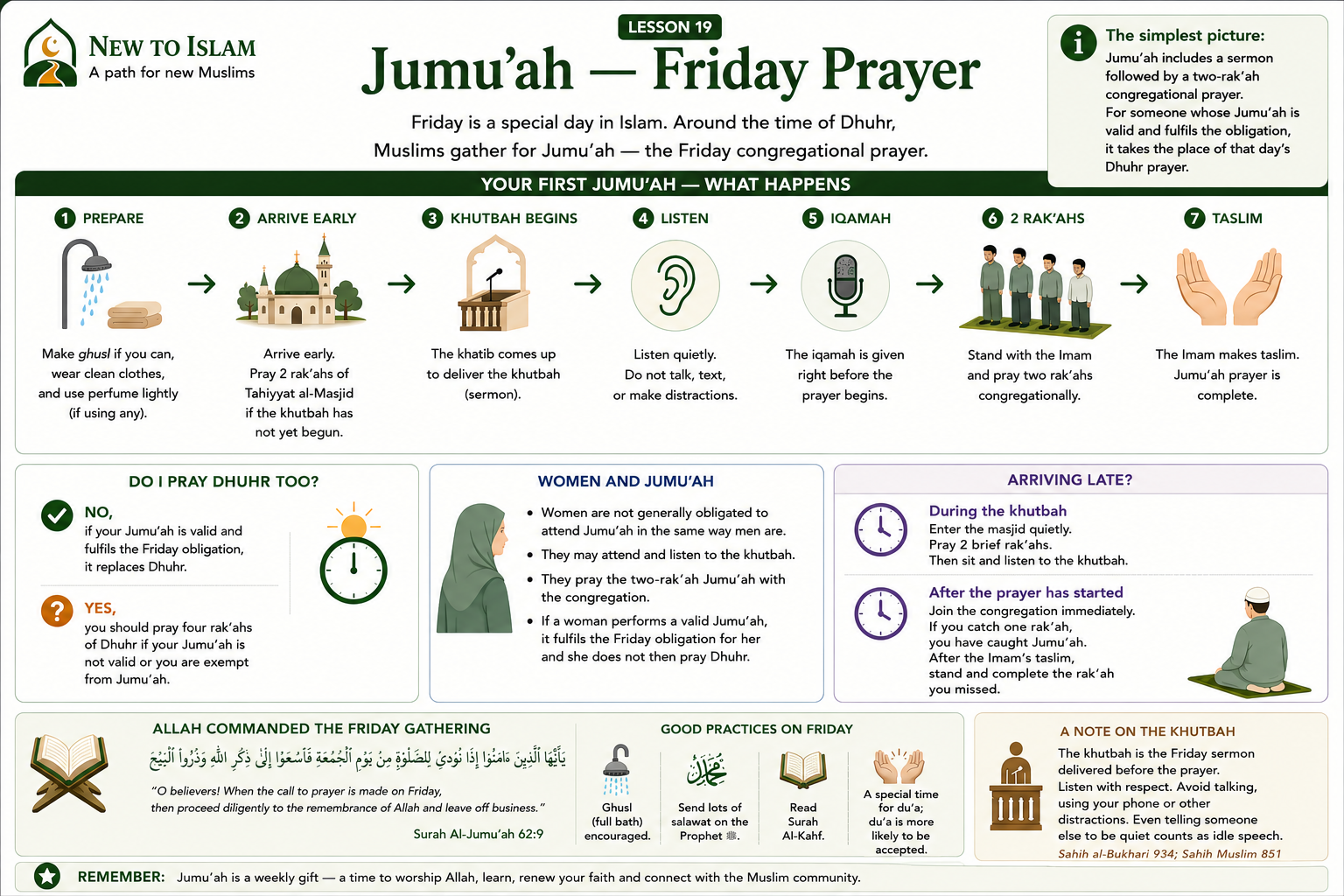
The simplest picture: Jumu'ah includes a sermon followed by a two-rak'ah congregational prayer. For someone whose Jumu'ah is valid and fulfils the obligation, it takes the place of that day's Dhuhr prayer.
Allah commanded the Friday gathering
يَـٰٓأَيُّهَا ٱلَّذِينَ ءَامَنُوٓا۟ إِذَا نُودِىَ لِلصَّلَوٰةِ مِن يَوْمِ ٱلْجُمُعَةِ فَٱسْعَوْا۟ إِلَىٰ ذِكْرِ ٱللَّهِ وَذَرُوا۟ ٱلْبَيْعَ
Yā ayyuhalladhīna āmanū idhā nūdiya liṣ-ṣalāti min yawmil-jumuʿati fasʿaw ilā dhikrillāhi wa dharul-bayʿ.
O believers! When the call to prayer is made on Friday, then proceed diligently to the remembrance of Allah and leave off business.
The next verse tells believers that when the prayer is finished, they may disperse through the land and seek Allah's bounty. Jumu'ah is therefore not an all-day replacement for ordinary life; it is a protected gathering for worship within the day.
What actually happens at Jumu'ah?
The central sequence is simple:
↓
Pray 2 rak'ahs of Tahiyyat al-Masjid — the greeting of the masjid
↓
Khutbah begins
↓
Listen to the khutbah
↓
Iqamah
↓
2 rak'ahs led by the Imam
↓
Taslim — prayer ends
How do I pray Tahiyyat al-Masjid?
Tahiyyat al-Masjid means the greeting of the masjid. When you enter the masjid, before sitting down, pray two rak'ahs.
You do not need to learn a completely new prayer for this. Pray the two rak'ahs using the same basic two-rak'ah Salah sequence you learned in Lesson 17 — How to Pray — Step by Step:
↓
Pray the first rak'ah
↓
Pray the second rak'ah
↓
Final sitting
↓
Tashahhud and the closing parts of the prayer
↓
Taslim — prayer ends
You do not need a special spoken intention or a special new set of words to memorize just for Tahiyyat al-Masjid. It is a two-rak'ah prayer. Use the prayer method you already learned.
If you have not yet memorized everything you say in Salah, use the beginner guidance in Lesson 17 and the Prayer Memorization Guide — What to Say in Salah. Being new does not mean you have to wait until everything is memorized before you enter the masjid and worship Allah.
What is the khutbah?
The khutbah is the Friday sermon delivered before the prayer.
The khatib addresses the congregation with remembrance of Allah, Qur'an, Islamic teaching, reminders and guidance.
The formal Friday khutbah has two parts, with the khatib sitting briefly between them.
When the khutbah is happening, listen. This is not the time for ordinary conversation, catching up with friends or scrolling on your phone.
The Prophet ﷺ warned that even telling another person to be quiet while the Imam is delivering the Friday khutbah counts as idle speech.
Sahih al-Bukhari 934; Sahih Muslim 851
How many rak'ahs is Jumu'ah?
The obligatory congregational Jumu'ah prayer itself is two rak'ahs, led by the Imam after the khutbah.
For a person whose Jumu'ah is valid and fulfils the Friday obligation, those two rak'ahs replace the normal four-rak'ah Dhuhr prayer for that day.
So no — you do not normally pray four rak'ahs of Dhuhr and then also pray the two-rak'ah Jumu'ah prayer. Jumu'ah is the Friday prayer for that time when its conditions are fulfilled.
Who is required to attend?
The detailed legal conditions belong in scholar-reviewed fiqh guidance, but a beginner should know the basic distinction:
Jumu'ah is an obligation for Muslim men who meet the relevant conditions and are not excused.
Women are permitted to attend Jumu'ah and their Jumu'ah prayer is valid, but attendance is not generally obligatory upon them in the same way.
Islamic law also recognizes exemptions and special circumstances, including matters such as illness and travel.
◇ Scholars differ
The schools of Islamic law discuss detailed conditions for whom Jumu'ah is obligatory, what counts as travel, congregation requirements, location, and other matters.
A person with an unusual situation should get qualified guidance rather than applying a simplified website sentence to every circumstance.
If you are a new Muslim woman
You are welcome to attend Jumu'ah where appropriate facilities are available.
Some masjids have a women's prayer area in the same hall; others have a separate room, balcony or floor. You may hear the Imam through speakers without seeing him directly.
That is why the congregational cues you learned earlier matter:
- Allāhu Akbar usually signals movement to the next prayer position.
- Samiʿ Allāhu liman ḥamidah signals that the Imam is rising from ruku'.
Follow the Imam's movements through the audible cues. Do not try to move ahead because you think you know what comes next.
When should I arrive?
Arrive with enough time to enter calmly, put away your shoes where the masjid expects them, find the appropriate prayer area and settle before the khutbah.
Jumu'ah can be busy. If you are unfamiliar with the building, arriving early makes the experience much easier.
Your first visit does not need to look polished. If you are unsure where to go, ask. “I'm new to Islam — where should I go for Jumu'ah?” is enough.
What should I wear?
Wear clean, modest clothing appropriate for Salah.
For the prayer itself, the normal requirements for covering the body in Salah apply. You do not need special “Friday clothes” for your prayer to count.
Friday does, however, have additional Sunnah practices connected with cleanliness and presenting oneself well.
Ghusl and preparing for Friday
Ghusl for Friday is strongly emphasized in the Sunnah.
The Prophet ﷺ strongly instructed Muslims concerning bathing for Friday.
Sahih al-Bukhari 877; Sahih Muslim 846
◇ Scholars differ
Scholars have discussed whether Friday ghusl is obligatory or a highly emphasized Sunnah in the relevant circumstances. The beginner takeaway is: take Friday cleanliness seriously and make ghusl part of your Friday preparation when able.
Other well-known Friday practices include wearing clean clothing, caring for personal hygiene and avoiding offensive odours before joining the congregation.
What about perfume?
Prophetic teachings encourage men attending Jumu'ah to present themselves cleanly and use pleasant fragrance when appropriate.
For women attending the masjid, rulings concerning fragrance outside the home require separate care. Do not turn a general “Friday perfume” reminder into a universal instruction for everyone.
What is the adhan? What is the iqamah?
The adhan is the call to prayer.
The iqamah is a shorter call immediately before the congregational obligatory prayer starts.
At Jumu'ah you may hear more than one adhan depending on the masjid's practice and the established Friday arrangement. Do not assume something has gone wrong because it differs from what you saw in a video or another masjid.
What if the khutbah is in a language I do not understand?
This is common in diverse Muslim communities.
A masjid may deliver the formal khutbah in Arabic, English or another language, or provide teaching or translation around it. Practices vary.
Even when you cannot understand everything, remain respectful and attentive. Ask the masjid whether a translation, summary or recording is available.
◇ Scholars differ
There are fiqh discussions about the language of the formal khutbah and which portions must be in Arabic. This website does not need a new Muslim to resolve that debate in order to attend Friday prayer.
What if I arrive while the khutbah is already happening?
Enter quietly and avoid distracting people.
Beginner instruction: Pray two brief rak'ahs of Tahiyyat al-Masjid, then sit and listen to the khutbah.
A man entered while the Prophet Muhammad ﷺ was delivering the Friday khutbah. The Prophet ﷺ instructed him to stand and pray two rak'ahs, and to make them brief.
Sahih Muslim 875
What if I arrive late for the prayer itself?
If the two-rak'ah Jumu'ah prayer has already begun, join the congregation immediately and follow the Imam from the position he is in. Do not stand at the back trying to restart the prayer from the beginning on your own.
If you catch one rak'ah of Jumu'ah with the Imam: you have caught Jumu'ah. When the Imam finishes with taslim, stand and complete the rak'ah you missed.
If you arrive too late to catch a rak'ah of Jumu'ah, the ordinary Dhuhr obligation remains, so you pray four rak'ahs of Dhuhr.
The Prophet Muhammad ﷺ taught that whoever catches one rak'ah of the Friday prayer should add another rak'ah to it.
Sunan Abi Dawud 1121
If you are unsure whether you caught the rak'ah, ask a knowledgeable person at the masjid after the prayer.
What if I cannot attend because of work or school?
If Jumu'ah is obligatory for you, it should be treated as a real religious obligation rather than an optional weekly activity.
At the same time, employment, school, illness, caregiving, travel and other circumstances can create genuine difficulties.
Do not simply decide that Jumu'ah “doesn't apply” because attending is inconvenient. But do not assume every difficult situation has exactly the same ruling either.
Learn the obligation, make a reasonable effort to arrange your schedule, and seek qualified guidance when you have a genuine barrier.
Do I pray Dhuhr if I miss Jumu'ah?
If you do not perform a valid Jumu'ah prayer, the ordinary Dhuhr obligation remains for that time.
So if Jumu'ah is not performed because you are exempt, unable to attend, or otherwise do not catch a valid Jumu'ah, you pray Dhuhr according to the applicable ruling.
What happens after Jumu'ah?
After the Imam ends the prayer with taslim, people may remain for dhikr, pray voluntary prayers, greet friends, attend announcements or leave.
Do not be surprised if different people do slightly different things after the obligatory prayer.
There are Sunnah prayers connected with Jumu'ah, and the details of what is prayed before or after can be taught separately without making your first Friday overwhelming.
Friday is more than the congregational prayer
Jumu'ah prayer is central, but Friday itself has additional virtues and Sunnah practices.
Among the practices Muslims commonly learn are:
- increasing prayers and blessings upon Prophet Muhammad ﷺ;
- making du'a;
- reading Surah Al-Kahf;
- taking special care with cleanliness; and
- remembering that Friday is a distinguished day of the Muslim week.
Your first Jumu'ah checklist
□ Check which entrance or prayer area to use if needed.
□ Make ghusl as part of your Friday preparation when able.
□ Wear clean, modest clothing suitable for Salah.
□ Make sure you have wudu before the prayer.
□ Arrive before the khutbah if possible.
□ Silence your phone.
□ Listen during the khutbah.
□ Follow the Imam for the two-rak'ah prayer.
If you feel nervous walking in, remember Lesson 11. You are not expected to know the building, the people and every local custom on your first Friday. You are there to worship Allah.
You have completed the Salah foundation
You now know:
- what Salah is;
- the basic step-by-step prayer sequence;
- when the five daily prayers are performed; and
- what happens at Jumu'ah.
You will keep improving your prayer throughout your life. The purpose of these lessons was not to make you an expert before you could begin. It was to give you enough of a map that the prayer no longer feels like an unexplained sequence everyone else somehow knows.
Islam is now your whole life, but you do not need to learn your whole religion today.