

Learning the words of Salah? You do not need to memorize everything at once. Keep our reusable Prayer Memorization Guide — What to Say in Salah open on your phone for the Arabic, transliteration, meaning and when each phrase is said.
This is the lesson where the pieces begin to come together.
You already know what Salah is, what a rak'ah is, and that Muslims pray five obligatory prayers each day.
Now you will learn the basic physical sequence of the prayer and the words that go with it.
Do not try to memorize this entire page in one sitting. First learn the shape of the prayer. Then add the words piece by piece. It is normal to need a learning aid while you are beginning.
Before you start
For an ordinary Salah, make sure:
- the prayer time has begun;
- you have the required ritual purification;
- your body, clothing and prayer place meet the cleanliness requirements;
- the parts of your body required to be covered for Salah are covered;
- you are facing the qiblah; and
- you know which prayer you intend to perform.
Your intention is in your heart. You do not need to announce a special intention formula aloud.
First: learn one rak'ah
A complete prayer is built from repeating a basic unit. So instead of seeing Salah as one long sequence, first learn the shape of one rak'ah.
Step 1 — Stand and begin the prayer
Stand facing the qiblah. Make the intention in your heart for the Salah you are about to perform.
Begin the prayer by saying:
اللَّهُ أَكْبَرُ
Allāhu Akbar
Allah is greater.
This opening is called Takbirat al-Ihram.
In the commonly taught Sunnah method, the hands are raised as the prayer begins and then placed while standing. There are recognized differences in hand position and some details of raising the hands.
If another Muslim places their hands somewhat differently from you, do not assume their prayer is wrong. Some visible details of Salah differ between recognized schools of Islamic law.
Step 2 — Recite while standing
The standing position is called qiyam.
The central Qur'anic recitation is Al-Fatihah.
بِسْمِ اللَّهِ الرَّحْمَٰنِ الرَّحِيمِ
الْحَمْدُ لِلَّهِ رَبِّ الْعَالَمِينَ
الرَّحْمَٰنِ الرَّحِيمِ
مَالِكِ يَوْمِ الدِّينِ
إِيَّاكَ نَعْبُدُ وَإِيَّاكَ نَسْتَعِينُ
اهْدِنَا الصِّرَاطَ الْمُسْتَقِيمَ
صِرَاطَ الَّذِينَ أَنْعَمْتَ عَلَيْهِمْ غَيْرِ الْمَغْضُوبِ عَلَيْهِمْ وَلَا الضَّالِّينَ
Bismillāhir-Raḥmānir-Raḥīm.
Al-ḥamdu lillāhi Rabbil-ʿālamīn.
Ar-Raḥmānir-Raḥīm.
Māliki yawmid-dīn.
Iyyāka naʿbudu wa iyyāka nastaʿīn.
Ihdinaṣ-ṣirāṭal-mustaqīm.
Ṣirāṭalladhīna anʿamta ʿalayhim ghayril-maghḍūbi ʿalayhim wa laḍ-ḍāllīn.
In the name of Allah, the Most Compassionate, the Most Merciful. All praise is for Allah, Lord of all worlds, the Most Compassionate, the Most Merciful, Master of the Day of Judgment. You alone we worship and You alone we ask for help. Guide us along the Straight Path, the path of those You have blessed — not those You are displeased with, or those who are astray.
After Al-Fatihah, additional Qur'an is recited in the places prescribed in the prayer. As a beginner, you will gradually learn short surahs for this purpose.
Al-Fatihah is important enough to have its own lesson. Lesson 24 will help you learn it carefully. For now, become familiar with its place inside the prayer.
But I do not know Al-Fatihah yet
This is one of the most important beginner questions.
If you became Muslim today and the next Salah arrives before you have memorized Al-Fatihah, do not decide that you must wait days or weeks before beginning to pray. Start learning Al-Fatihah immediately, but pray according to what you are genuinely able to do while you are learning.
The Prophet Muhammad ﷺ gave guidance to a man who said that he could not memorize anything from the Qur'an. He taught him words of remembrance of Allah that he could say instead.
The Prophet ﷺ taught a man who could not memorize Qur'an to say words including: Subḥān Allāh, wal-ḥamdu lillāh, wa lā ilāha illā Allāh, wallāhu Akbar, wa lā ḥawla wa lā quwwata illā billāh.
Sunan Abi Dawud 832
سُبْحَانَ اللَّهِ، وَالْحَمْدُ لِلَّهِ، وَلَا إِلَهَ إِلَّا اللَّهُ، وَاللَّهُ أَكْبَرُ، وَلَا حَوْلَ وَلَا قُوَّةَ إِلَّا بِاللَّهِ
Subḥān Allāh, wal-ḥamdu lillāh, wa lā ilāha illā Allāh, wallāhu Akbar, wa lā ḥawla wa lā quwwata illā billāh.
Glory be to Allah; all praise belongs to Allah; there is no deity worthy of worship except Allah; Allah is greater; and there is no power and no strength except through Allah.
Another authentic report teaches that if a person knows some Qur'an, they should recite what they know; if they do not, they should praise Allah, declare His greatness and affirm that none has the right to be worshipped except Him.
So what should you do for your next prayer? Learn and perform the physical sequence taught on this page. If you genuinely cannot yet recite Al-Fatihah or other Qur'an, use the remembrance above as temporary beginner guidance while actively learning Al-Fatihah. Do not treat the temporary substitute as a reason to delay learning the Qur'an recitation required for Salah.
Memorizing Al-Fatihah and the prayer phrases? Use the Prayer Memorization Guide as your practice reference instead of searching through this whole lesson each time.
You can begin worshipping Allah while you are still learning. Your inability today is not the same as refusing to learn. Keep practising Al-Fatihah steadily and ask a qualified teacher to listen to you as you improve.
Step 3 — Bow
Say:
Allāhu Akbar
Allah is greater.
Then move into ruku' — the bowing position.
Bow with your hands supported on your knees and your body settled into the bow.
In ruku', say:
سُبْحَانَ رَبِّيَ الْعَظِيمِ
Subḥāna Rabbiyal-ʿAẓīm
Glory be to my Lord, the Magnificent.
A commonly taught Sunnah practice is to say this three times. Do not let counting become a source of anxiety.
Step 4 — Rise from bowing
This transition is different from the others.
When rising from ruku', the person praying alone — and the Imam when leading — says:
سَمِعَ اللَّهُ لِمَنْ حَمِدَهُ
Samiʿ Allāhu liman ḥamidah
Allah hears the one who praises Him.
After standing upright, say:
رَبَّنَا وَلَكَ الْحَمْدُ
Rabbanā wa lakal-ḥamd
Our Lord, to You belongs all praise.
Remember this from Lesson 11: if you are praying behind an Imam whom you cannot see, this phrase — Samiʿ Allāhu liman ḥamidah — is the audible cue that the Imam is rising from ruku'. Most other major transitions are signalled by Allāhu Akbar.
Step 5 — Prostrate
Say Allāhu Akbar and move into sujood.
In prostration, the forehead and nose, hands, knees and toes are placed in the prescribed position.
Say:
سُبْحَانَ رَبِّيَ الْأَعْلَى
Subḥāna Rabbiyal-Aʿlā
Glory be to my Lord, the Most High.
A commonly taught Sunnah practice is to say this three times.
Sujood is one of the most distinctive moments of Salah. You are physically lowering yourself before Allah alone. Muslims do not perform this act of worship for another person, object or created being.
Step 6 — Sit briefly
Say Allāhu Akbar and rise into a sitting position between the two prostrations.
A simple supplication taught here is:
رَبِّ اغْفِرْ لِي
Rabbighfir lī
My Lord, forgive me.
Step 7 — Prostrate again
Say Allāhu Akbar and make the second sujood.
Again say:
سُبْحَانَ رَبِّيَ الْأَعْلَى
Subḥāna Rabbiyal-Aʿlā
Glory be to my Lord, the Most High.
You have now completed one rak'ah.
Step 8 — Begin the next rak'ah
If the prayer continues, say Allāhu Akbar and stand for the next rak'ah.
You again recite Al-Fatihah and continue through the prayer sequence.
After two rak'ahs, there is an important sitting called the tashahhud.
The tashahhud
During the sitting, Muslims recite the testimony taught by the Prophet ﷺ:
التَّحِيَّاتُ لِلَّهِ وَالصَّلَوَاتُ وَالطَّيِّبَاتُ، السَّلَامُ عَلَيْكَ أَيُّهَا النَّبِيُّ وَرَحْمَةُ اللَّهِ وَبَرَكَاتُهُ، السَّلَامُ عَلَيْنَا وَعَلَى عِبَادِ اللَّهِ الصَّالِحِينَ، أَشْهَدُ أَنْ لَا إِلَهَ إِلَّا اللَّهُ، وَأَشْهَدُ أَنَّ مُحَمَّدًا عَبْدُهُ وَرَسُولُهُ
At-taḥiyyātu lillāhi waṣ-ṣalawātu waṭ-ṭayyibāt. As-salāmu ʿalayka ayyuhan-nabiyyu wa raḥmatullāhi wa barakātuh. As-salāmu ʿalaynā wa ʿalā ʿibādillāhiṣ-ṣāliḥīn. Ashhadu an lā ilāha illā Allāh, wa ashhadu anna Muḥammadan ʿabduhu wa rasūluh.
All greetings, prayers and good things belong to Allah. Peace be upon you, O Prophet, and the mercy of Allah and His blessings. Peace be upon us and upon the righteous servants of Allah. I testify that there is no deity worthy of worship except Allah, and I testify that Muhammad is His servant and Messenger.
This looks like a lot because it is new. Do not stare at the whole paragraph and think you must memorize it tonight. Learn it phrase by phrase.
What happens after two rak'ahs?
That depends on which prayer you are performing.
Rak'ahs 3 and 4
In the third and fourth rak'ahs of the obligatory prayers, Al-Fatihah is recited and the same bowing and prostration sequence continues.
After the final rak'ah, remain sitting for the final tashahhud and the concluding recitations.
The final sitting — what do I say?
After the final rak'ah, remain sitting. The final sitting brings several recitations together, so it helps to learn them in order.
↓
2. Salat Ibrahimiyyah — blessings upon the Prophet ﷺ
↓
3. Supplication before finishing
↓
4. Taslim — end the prayer
1 — Recite the tashahhud
In the final sitting, recite the full tashahhud that you learned above. Do not skip it simply because the Salat Ibrahimiyyah comes next.
Beginner reminder: in a three- or four-rak'ah prayer, you sat after the second rak'ah for tashahhud and then stood again. After the final rak'ah, you remain sitting, recite the tashahhud again, and continue with the concluding recitations below.
2 — Send blessings upon the Prophet ﷺ
After the tashahhud in the final sitting, Muslims send blessings upon Prophet Muhammad ﷺ. A well-known form is:
اللَّهُمَّ صَلِّ عَلَى مُحَمَّدٍ وَعَلَى آلِ مُحَمَّدٍ كَمَا صَلَّيْتَ عَلَى إِبْرَاهِيمَ وَعَلَى آلِ إِبْرَاهِيمَ إِنَّكَ حَمِيدٌ مَجِيدٌ، اللَّهُمَّ بَارِكْ عَلَى مُحَمَّدٍ وَعَلَى آلِ مُحَمَّدٍ كَمَا بَارَكْتَ عَلَى إِبْرَاهِيمَ وَعَلَى آلِ إِبْرَاهِيمَ إِنَّكَ حَمِيدٌ مَجِيدٌ
Allāhumma ṣalli ʿalā Muḥammadin wa ʿalā āli Muḥammad, kamā ṣallayta ʿalā Ibrāhīma wa ʿalā āli Ibrāhīm, innaka Ḥamīdun Majīd. Allāhumma bārik ʿalā Muḥammadin wa ʿalā āli Muḥammad, kamā bārakta ʿalā Ibrāhīma wa ʿalā āli Ibrāhīm, innaka Ḥamīdun Majīd.
O Allah, send Your grace upon Muhammad and the family of Muhammad as You sent Your grace upon Ibrahim and the family of Ibrahim. You are indeed Praiseworthy, Glorious. O Allah, bless Muhammad and the family of Muhammad as You blessed Ibrahim and the family of Ibrahim. You are indeed Praiseworthy, Glorious.
3 — Make supplication before the taslim
The Prophet Muhammad ﷺ taught an important supplication to say after the final tashahhud before ending the prayer. In it, you seek Allah's protection from four serious trials.
The Prophet ﷺ instructed that after completing the final tashahhud, a person should seek refuge with Allah from four things: the punishment of Hell, the punishment of the grave, the trials of life and death, and the evil of the trial of the False Messiah.
Sahih Muslim 588
اللَّهُمَّ إِنِّي أَعُوذُ بِكَ مِنْ عَذَابِ جَهَنَّمَ، وَمِنْ عَذَابِ الْقَبْرِ، وَمِنْ فِتْنَةِ الْمَحْيَا وَالْمَمَاتِ، وَمِنْ شَرِّ فِتْنَةِ الْمَسِيحِ الدَّجَّالِ
Allāhumma innī aʿūdhu bika min ʿadhābi Jahannam, wa min ʿadhābil-qabr, wa min fitnatil-maḥyā wal-mamāt, wa min sharri fitnatil-Masīḥid-Dajjāl.
O Allah, I seek refuge in You from the punishment of Hell, from the punishment of the grave, from the trials of life and death, and from the evil of the trial of the False Messiah.
You may already know this du'a from another context. This lesson is teaching its established place near the end of Salah: after the final tashahhud and before the taslim. Do not worry if you have not memorized it yet; add it gradually as you learn.
Step 9 — Finish the prayer
The prayer ends with the taslim.
Turn your head to the right and say:
السَّلَامُ عَلَيْكُمْ وَرَحْمَةُ اللَّهِ
As-salāmu ʿalaykum wa raḥmatullāh
Peace and the mercy of Allah be upon you.
Then turn to the left and say it again.
Your obligatory Salah is now complete.
What do I say after the obligatory Salah?
After the taslim, you may notice Muslims remain sitting and continue remembering Allah. These are adhkar after Salah. They come after the obligatory prayer has ended; they are not additional rak'ahs or another part of the obligatory Salah itself.
You do not need to memorize all of these on your first day. Begin with the first short remembrance and add the others gradually.
1 — Ask Allah's forgiveness three times
أَسْتَغْفِرُ اللَّهَ
Astaghfirullāh
I seek Allah's forgiveness.
Then say:
اللَّهُمَّ أَنْتَ السَّلَامُ وَمِنْكَ السَّلَامُ تَبَارَكْتَ ذَا الْجَلَالِ وَالْإِكْرَامِ
Allāhumma anta as-Salām, wa minka as-salām, tabārakta dhal-jalāli wal-ikrām.
O Allah, You are Peace, and from You is peace. Blessed are You, Possessor of Majesty and Honour.
When the Messenger of Allah ﷺ finished his prayer, he sought Allah's forgiveness three times and then said, “O Allah, You are Peace, and from You is peace. Blessed are You, Possessor of Majesty and Honour.”
Sahih Muslim 591
2 — Recite Ayat al-Kursi
Another established remembrance after each obligatory prayer is Ayat al-Kursi — Qur'an 2:255.
A hadith from Abu Umamah رضي الله عنه reports that whoever recites Ayat al-Kursi after every obligatory prayer has nothing preventing entry into Paradise except death.
3 — Glorify, praise and magnify Allah
The Prophet Muhammad ﷺ taught remembrance after every prayer using these counts:
سُبْحَانَ اللَّهِ
Subḥānallāh — 33 times
Glory be to Allah.
الْحَمْدُ لِلَّهِ
Alḥamdulillāh — 33 times
All praise belongs to Allah.
اللَّهُ أَكْبَرُ
Allāhu Akbar — 33 times
Allah is greater.
That makes 99. Complete 100 by saying once:
لَا إِلَهَ إِلَّا اللَّهُ وَحْدَهُ لَا شَرِيكَ لَهُ، لَهُ الْمُلْكُ وَلَهُ الْحَمْدُ، وَهُوَ عَلَى كُلِّ شَيْءٍ قَدِيرٌ
Lā ilāha illā Allāhu waḥdahu lā sharīka lah, lahul-mulku wa lahul-ḥamd, wa Huwa ʿalā kulli shay'in qadīr.
There is no deity worthy of worship except Allah alone, without partner. To Him belongs all sovereignty and all praise, and He has power over everything.
The Prophet ﷺ taught saying Subhanallah thirty-three times, Alhamdulillah thirty-three times and Allahu Akbar thirty-three times after every prayer, then completing one hundred with the declaration of Allah's oneness above.
Sahih Muslim 597
4 — Recite the protecting surahs
The Prophet ﷺ commanded recitation of the Mu'awwidhat after every prayer. These are the short closing surahs you will learn in the Qur'an section:
- Surah Al-Ikhlas — Surah 112
- Surah Al-Falaq — Surah 113
- Surah An-Nas — Surah 114
Uqbah ibn Amir رضي الله عنه reported that the Messenger of Allah ﷺ commanded him to recite the Mu'awwidhat after every prayer.
Sunan Abi Dawud 1523 — graded Sahih
If you see people remain seated after the congregational prayer, this may be what they are doing. The taslim ended the obligatory Salah. They are now remembering Allah with adhkar taught for after the prayer. As a beginner, learn these steadily rather than feeling that you must memorize the whole list immediately.
Want one place to practise all of these words? The Prayer Memorization Guide includes the Salah recitations and these after-prayer adhkar in one phone-friendly reference.
The whole prayer at a glance
The ending changes depending on whether the obligatory prayer has two, three or four rak'ahs. These separate flows make that distinction clear.
↓
Rak'ah 2 — complete the second rak'ah
↓
Final sitting
↓
Tashahhud
↓
Salat Ibrahimiyyah — blessings upon the Prophet ﷺ
↓
Supplication before Taslim
↓
Taslim
↓
Rak'ah 2 — complete the second rak'ah
↓
Sit and recite the Tashahhud
↓
Stand for Rak'ah 3
↓
Final sitting
↓
Tashahhud
↓
Salat Ibrahimiyyah — blessings upon the Prophet ﷺ
↓
Supplication before Taslim
↓
Taslim
↓
Rak'ah 2 — complete the second rak'ah
↓
Sit and recite the Tashahhud
↓
Stand for Rak'ah 3
↓
Rak'ah 4
↓
Final sitting
↓
Tashahhud
↓
Salat Ibrahimiyyah — blessings upon the Prophet ﷺ
↓
Supplication before Taslim
↓
Taslim
The key difference: Fajr ends after two rak'ahs. Maghrib continues for one more rak'ah after the first tashahhud. Dhuhr, Asr and Isha continue for two more rak'ahs after the first tashahhud.
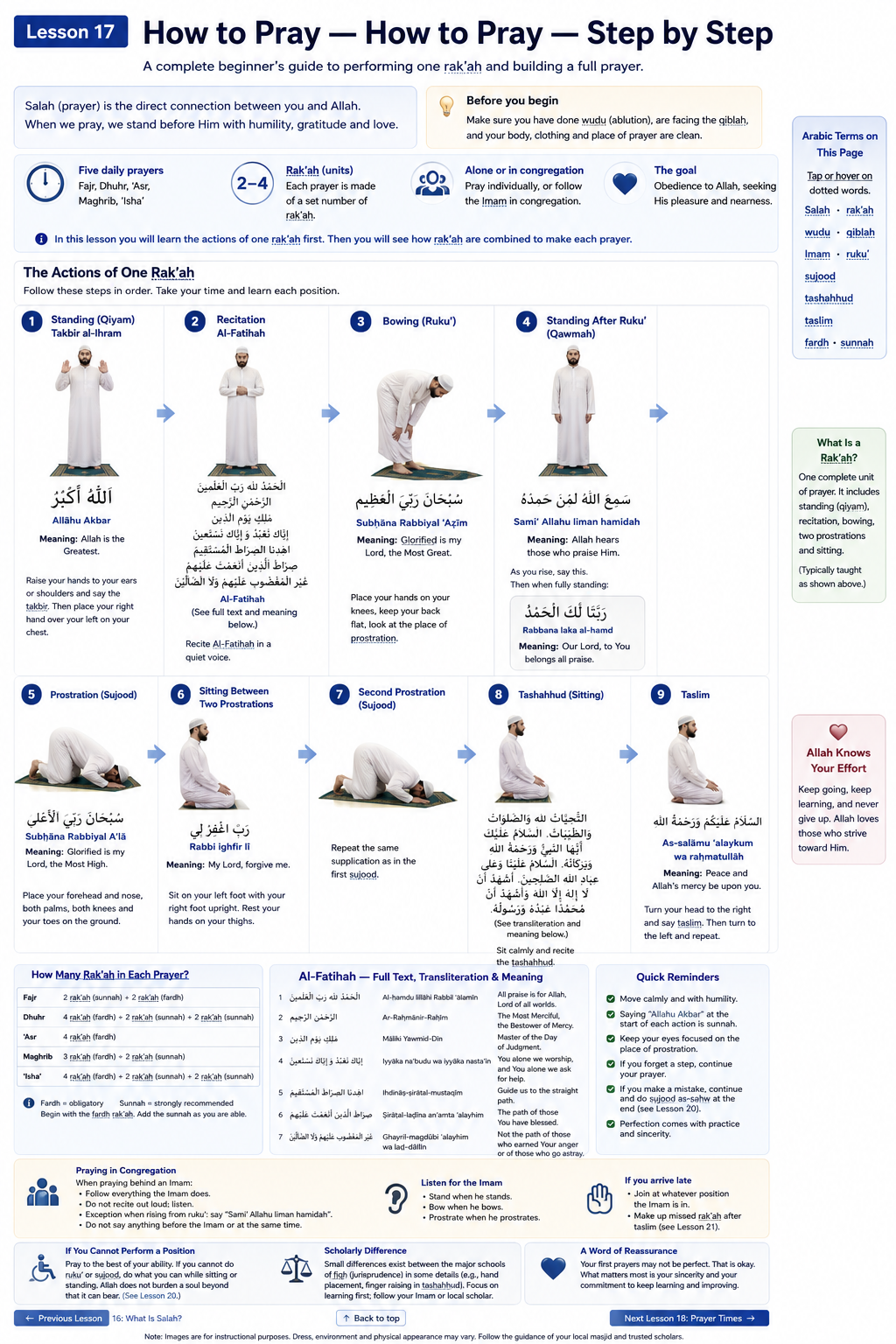
See the prayer sequence
This visual brings the positions and core recitations together on one page. Use it as an orientation guide while you learn the fuller instructions above.
What if I cannot stand?
Islam does not require a person to perform a physical position they are genuinely unable to perform.
The Prophet ﷺ gave guidance to pray standing if able, sitting if unable to stand, and with further accommodation when sitting is also not possible.
The Prophet ﷺ instructed Imran ibn Husayn رضي الله عنه to pray standing; if unable, then sitting; and if unable, then on his side.
Sahih al-Bukhari 1117
If disability, injury, dizziness, pregnancy, surgery or illness affects your prayer positions, get guidance for your actual abilities rather than hurting yourself trying to imitate a position you cannot safely maintain.
What if I lose track of the rak'ahs?
This happens even to experienced Muslims.
Islam has rulings for uncertainty and mistakes in Salah, including sujood as-sahw — prostrations related to forgetfulness.
You do not need to master those rules before learning your first prayer. If you make a mistake while learning, do not panic. Learn what happened and ask for guidance when needed.
If you are praying behind an Imam
The sequence is the same, but the Imam leads the congregation.
Follow him; do not move ahead of him.
If you cannot see him, listen for the transition cues:
- Allāhu Akbar usually signals movement to the next position.
- Samiʿ Allāhu liman ḥamidah signals that the Imam is rising from ruku'.
There are important differences in what a person praying behind the Imam recites during audible and quiet prayers. Those details vary in some respects among recognized schools and should be taught with the congregational-prayer guidance rather than guessed from what neighbouring worshippers appear to be doing.
◇ Scholars differ
Hand placement: recognized schools differ over where the hands are placed while standing.
Raising the hands: there are differences concerning the points in Salah at which the hands are raised.
Finger position in tashahhud: details differ among schools.
Recitation behind the Imam: there are important differences concerning Al-Fatihah and other recitation when praying in congregation.
Some sitting and movement details: visible variations do not necessarily mean one person's Salah is invalid.
Do not let legitimate differences distract you from learning the prayer. Start with a coherent method taught by a qualified teacher, then learn the differences later.
A realistic way to learn this
Instead of trying to memorize everything at once:
- Learn the movement sequence.
- Learn Allāhu Akbar and the short phrases for ruku', standing and sujood.
- Work steadily on Al-Fatihah.
- Learn the tashahhud phrase by phrase.
- Add the final blessings and supplications.
Practise outside prayer time as well. You can rehearse the sequence without pretending that the practice itself is an obligatory Salah.
Your first goal is not elegance. Your first goal is to worship Allah as correctly as you currently know how, while continuing to learn.
Your next step
Keep this lesson available while you practise. Do not be embarrassed to need a guide.
Next we will make the daily schedule itself clear: when each of the five prayers begins and ends, and why those times move throughout the year.
Continue to Lesson 18 — Prayer Times — When Muslims Pray ↑