

If you recently became Muslim, you probably said words called the Shahadah.
You may have repeated them after someone. You may have said them in Arabic even though you did not yet understand every word. Or you may have understood the meaning before you knew how to pronounce the Arabic.
This lesson is about what you just said — and why those words matter.
The Shahadah
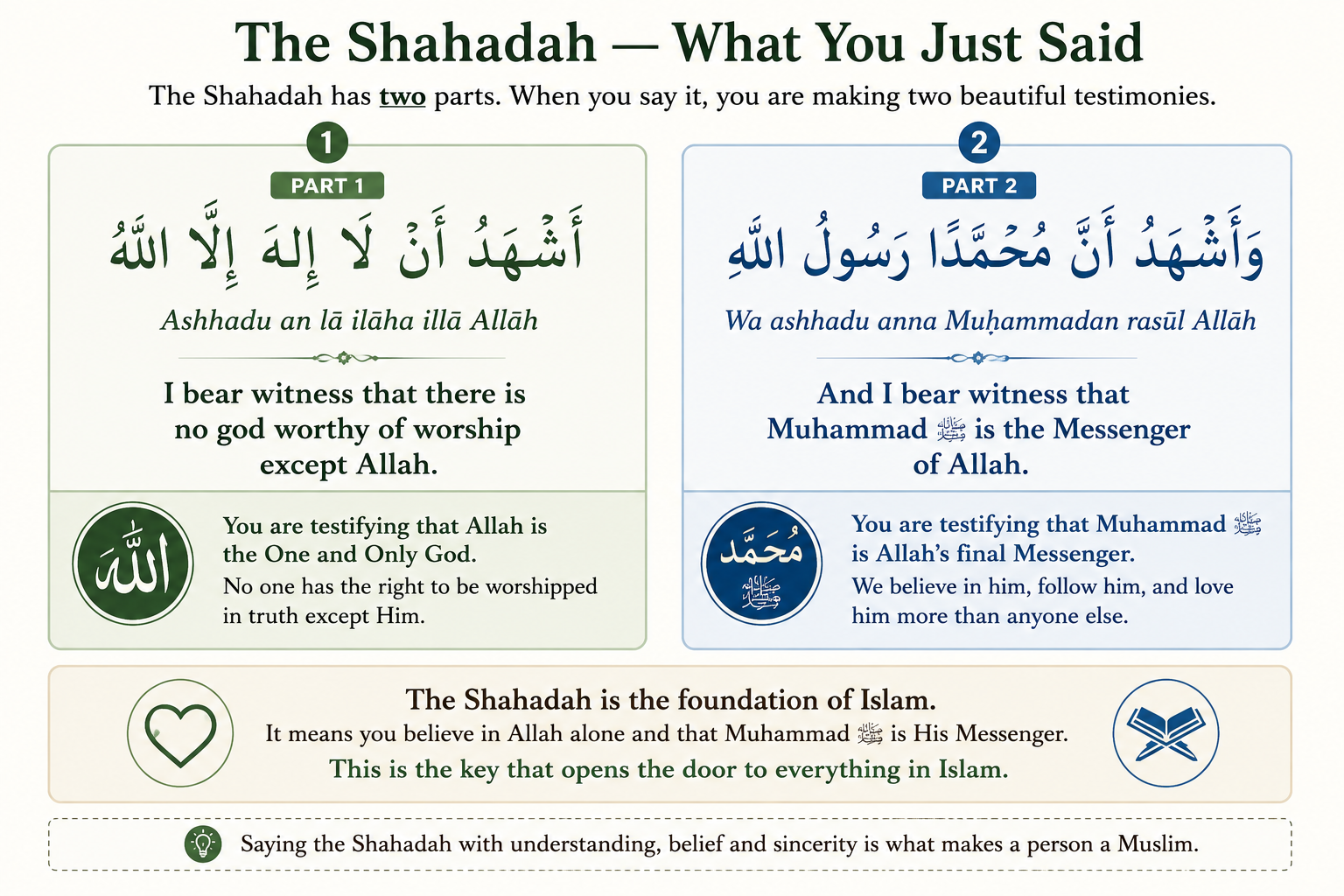
أَشْهَدُ أَنْ لَا إِلٰهَ إِلَّا اللهُ، وَأَشْهَدُ أَنَّ مُحَمَّدًا رَسُولُ اللهِ
Ashhadu an lā ilāha illā Allāh, wa ashhadu anna Muḥammadan rasūl Allāh.
I bear witness that there is no god worthy of worship except Allah, and I bear witness that Muhammad ﷺ is the Messenger of Allah.
The Shahadah has two parts. Together, they express the foundation of what you have accepted as a Muslim.
Part 1 — Allah alone is worthy of worship
Ashhadu an lā ilāha illā Allāh means:
I bear witness that there is no god worthy of worship except Allah.
You are affirming that Allah alone has the right to be worshipped. He has no partners in worship.
This is the heart of Tawhid — recognizing Allah as One and directing worship to Him alone.
Your worship is for Allah alone. You do not worship another being alongside Him or direct your worship through another being as a partner, intercessor, or helper.
فَٱعْلَمْ أَنَّهُۥ لَآ إِلَـٰهَ إِلَّا ٱللَّهُ
Faʿlam annahu lā ilāha illā Allāh.
So know that there is no god worthy of worship except Allah.
You will explore who Allah is in the next lesson. For now, hold onto this foundation: you can worship Allah directly. You do not need another person to carry your prayers to Him.
Part 2 — Muhammad ﷺ is Allah's Messenger
Wa ashhadu anna Muḥammadan rasūl Allāh means:
And I bear witness that Muhammad ﷺ is the Messenger of Allah.
You are affirming that Muhammad ﷺ was sent by Allah with His guidance and that you accept him as Allah's last and final Messenger. No messenger will come after Muhammad ﷺ.
مُّحَمَّدٌۭ رَّسُولُ ٱللَّهِ
Muḥammadun rasūlu-llāh
Muhammad is the Messenger of Allah.
This does not mean Muslims worship Muhammad ﷺ. We do not. He is Allah's servant and Messenger.
You will learn who he was, how revelation began, what happened in Makkah and Madinah, and why Muslims try to follow his Sunnah in Lesson 9.
What changed when you said it?
You entered Islam by affirming these two truths. From here, Islam is not something you are expected to understand all at once. It is something you will learn and live step by step.
The Prophet Muhammad ﷺ placed this testimony at the foundation of Islam. In a well-known authentic hadith, he taught that Islam is built on five, beginning with the testimony of faith.
Islam is built on five, beginning with testimony that Allah alone is to be worshipped and Muhammad ﷺ is His Messenger.
Sahih al-Bukhari 8
You will meet the other four pillars soon. You do not need to master them on this page.
What did not happen?
Becoming Muslim did not require you to become a different ethnicity, erase your personality, abandon your language, or somehow know everything Muslims around you may have learned since childhood.
You are beginning a new relationship with Allah, but you are still you.
Some parts of your life may change as you learn what Islam teaches. Some things may change quickly; others may take time to understand and put into practice. Learning slowly is not the same as not caring.
A useful rule for your first weeks: when you do not know something, ask. When you make a mistake, learn. When something feels overwhelming, return to the foundations instead of trying to learn the whole religion at once.
What if my Arabic was not perfect?
Do not let imperfect pronunciation make you think your beginning was meaningless. Arabic takes time to learn. Keep practising the Shahadah so that the words and their meaning become familiar together.
What matters is that you know what you are affirming and that you are saying it sincerely. If you have a particular concern about how your Shahadah was taken, ask a trusted qualified Imam or teacher rather than carrying the worry alone.
Four words to know from this lesson
- Shahadah — the testimony of faith.
- Allah — God; the One Muslims worship.
- Tawhid — the oneness of Allah and worshipping Him alone.
- Messenger — a person chosen by Allah to convey His guidance. You will learn more about Prophets and Messengers in Lesson 7.
Your next step
For now, read the Shahadah again slowly and connect each half to its meaning:
- Allah alone is worthy of worship. He has no partners in worship.
- Muhammad ﷺ is Allah's last and final Messenger. No messenger will come after him.
That is enough for this lesson.
You are not behind. You have just begun. Islam is now your whole life, but you do not need to learn your whole religion today.