

Istikhara is a way of asking Allah to guide you when you are making a permissible decision and you do not know which choice will be better for you.
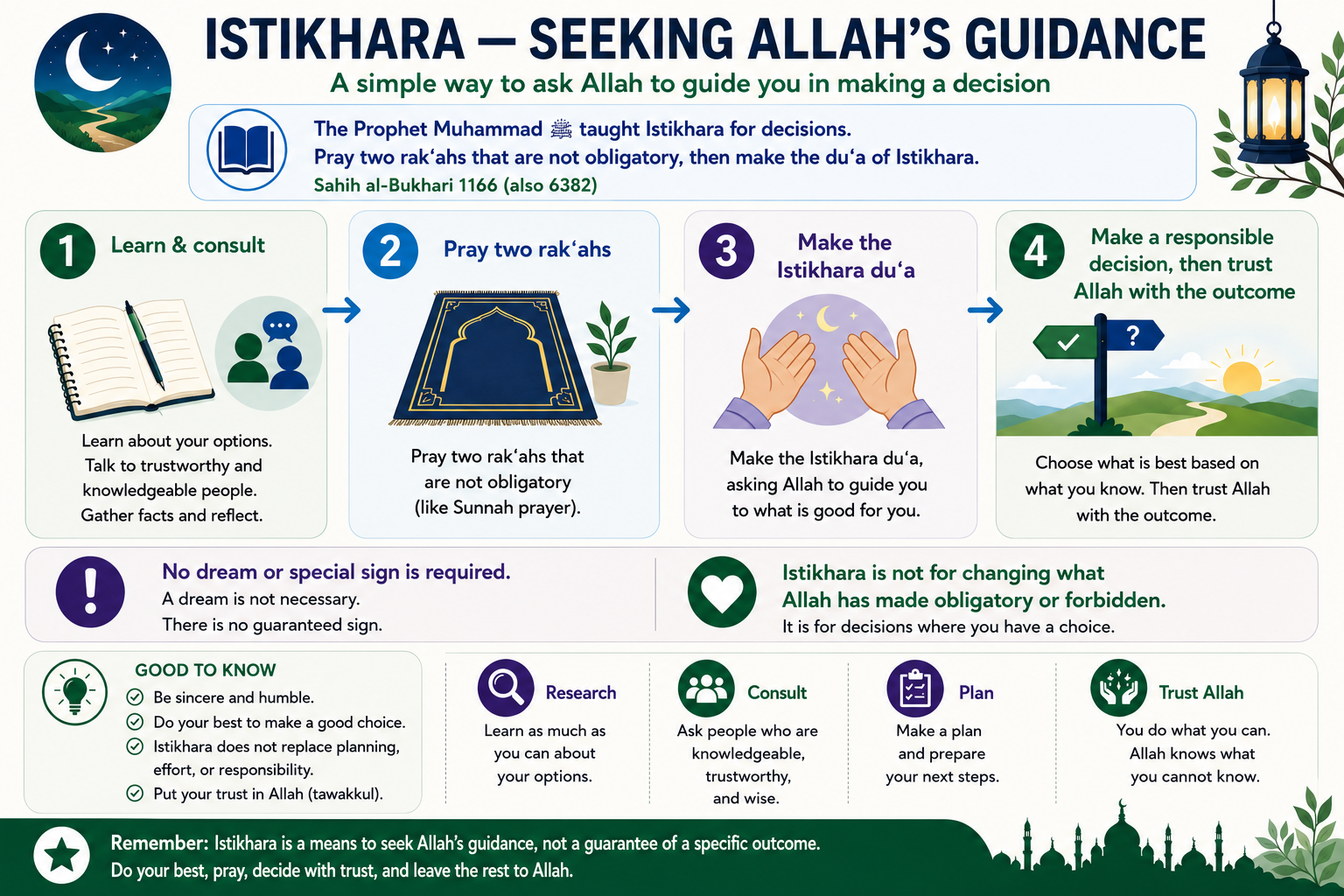
It does not replace thinking, research, good advice or responsibility. You learn what you can, consult trustworthy people, pray two non-obligatory rak‘ahs, make the Istikhara du‘a, then make a responsible decision and trust Allah with the outcome.
No dream or special sign is required. Istikhara is not a test of whether you receive a dream, a colour, a feeling, or an unusual event. You are asking Allah for what is good, then moving forward responsibly.
What the Prophet Muhammad ﷺ taught
Jabir ibn ‘Abdullah رضي الله عنه reported that the Prophet Muhammad ﷺ used to teach the Companions Istikhara for their matters as he taught them a surah of the Qur'an. He instructed the person who intended a matter to pray two rak‘ahs other than the obligatory prayer and then make the Istikhara du‘a.
Sahih al-Bukhari 1166; also 6382. Summarized here for beginner reading.
When should I use Istikhara?
Use Istikhara when you have a real choice between permissible options and you want Allah to guide you to what is good.
Examples might include choosing between jobs, deciding whether to move, considering a course of study, deciding whether to proceed with a marriage proposal, or making another important personal decision.
Istikhara is not for deciding whether to obey something Allah has already made obligatory or whether to do something He has forbidden.
Example: You do not pray Istikhara to decide whether to pray Fajr. Fajr is already obligatory. But you might pray Istikhara when deciding between two suitable job offers.
Step 1 — Learn and consult
Before making a decision, gather the information you reasonably need. Ask questions. Think about possible benefits and harms. If appropriate, speak with people who are knowledgeable, trustworthy and wise.
ShuraConsultation — seeking useful advice from trustworthy and knowledgeable people before making a decision. and Istikhara work well together. Asking Allah for guidance does not mean you stop using the mind, experience and advice Allah has given you.
Step 2 — Pray two rak‘ahs
Pray two rak‘ahs of non-obligatory Salah. The two rak‘ahs use the same basic prayer structure you already learn for Salah.
Need help with the prayer itself?
Use Lesson 17 — How to Pray — Step by Step.
You do not need a special new set of movements for Istikhara. Pray the two rak‘ahs as a voluntary prayer.
Step 3 — Make the Istikhara du‘a
After the two rak‘ahs, make the du‘a taught by the Prophet Muhammad ﷺ. The hadith instructs the worshipper to pray the two non-obligatory rak‘ahs and then say the supplication below. Detailed discussion about the exact placement of the du‘a and whether the hands are raised remains for scholar review.
اللَّهُمَّ إِنِّي أَسْتَخِيرُكَ بِعِلْمِكَ، وَأَسْتَقْدِرُكَ بِقُدْرَتِكَ، وَأَسْأَلُكَ مِنْ فَضْلِكَ الْعَظِيمِ، فَإِنَّكَ تَقْدِرُ وَلَا أَقْدِرُ، وَتَعْلَمُ وَلَا أَعْلَمُ، وَأَنْتَ عَلَّامُ الْغُيُوبِ. اللَّهُمَّ إِنْ كُنْتَ تَعْلَمُ أَنَّ هَذَا الْأَمْرَ خَيْرٌ لِي فِي دِينِي وَمَعَاشِي وَعَاقِبَةِ أَمْرِي، فَاقْدُرْهُ لِي وَيَسِّرْهُ لِي، ثُمَّ بَارِكْ لِي فِيهِ. وَإِنْ كُنْتَ تَعْلَمُ أَنَّ هَذَا الْأَمْرَ شَرٌّ لِي فِي دِينِي وَمَعَاشِي وَعَاقِبَةِ أَمْرِي، فَاصْرِفْهُ عَنِّي وَاصْرِفْنِي عَنْهُ، وَاقْدُرْ لِيَ الْخَيْرَ حَيْثُ كَانَ، ثُمَّ أَرْضِنِي بِهِ.
Transliteration:
Allahumma inni astakhiruka bi ‘ilmika, wa astaqdiruka bi qudratika, wa as’aluka min fadlika al-‘azim. Fa innaka taqdiru wa la aqdiru, wa ta‘lamu wa la a‘lamu, wa anta ‘allamu al-ghuyub. Allahumma in kunta ta‘lamu anna hadha al-amra khayrun li fi dini wa ma‘ashi wa ‘aqibati amri, faqdurhu li wa yassirhu li, thumma barik li fihi. Wa in kunta ta‘lamu anna hadha al-amra sharrun li fi dini wa ma‘ashi wa ‘aqibati amri, fasrifhu ‘anni wasrifni ‘anhu, waqdur liya al-khayra haythu kana, thumma ardini bihi.
Meaning:
O Allah, I seek what is good through Your knowledge, and I seek ability through Your power, and I ask You from Your tremendous bounty. You are able and I am not; You know and I do not; and You are the Knower of the unseen. O Allah, if You know that this matter is good for me in my religion, my livelihood and the outcome of my affair, then decree it for me, make it easy for me and bless it for me. And if You know that this matter is bad for me in my religion, my livelihood and the outcome of my affair, then turn it away from me and turn me away from it. Decree for me what is good wherever it may be, then make me content with it.
Based on the du‘a reported in Sahih al-Bukhari 1166 and 6382.
What does “this matter” mean?
In the du‘a, you reach the words “this matter” — hadha al-amr. The hadith says that the person then mentions their need or matter.
For example, your matter might be accepting a particular job, moving to a particular city, or proceeding with a particular marriage proposal.
You do not need to turn this into a complicated formula. Know clearly what decision you are asking Allah about. The precise details of when and how the matter is named remain for scholar review.
Step 4 — Decide responsibly and trust Allah
After Istikhara, continue using the information and trustworthy advice available to you. Make the best responsible decision you can, then place your trust in Allah.
TawakkulReliance upon Allah — doing what you reasonably can, then trusting Allah with what is beyond your control. does not mean doing nothing. It means taking responsible steps while knowing that Allah knows what you cannot know.
وَعَسَىٰ أَن تَكْرَهُوا شَيْئًا وَهُوَ خَيْرٌ لَّكُمْ ۖ وَعَسَىٰ أَن تُحِبُّوا شَيْئًا وَهُوَ شَرٌّ لَّكُمْ ۗ وَاللَّهُ يَعْلَمُ وَأَنتُمْ لَا تَعْلَمُونَ
Wa ‘asa an takrahu shay’an wa huwa khayrun lakum, wa ‘asa an tuhibbu shay’an wa huwa sharrun lakum, wallahu ya‘lamu wa antum la ta‘lamun.
Perhaps you dislike something which is good for you and like something which is bad for you. Allah knows and you do not know.
This verse was revealed in a different immediate context, but its final reminder is important here: Allah knows what we do not know. Istikhara is an expression of that humility and trust.
Do I need a dream?
No dream is required. You also do not need to wait for a special colour, a voice, a sudden feeling, or an unusual sign before making your decision.
Do not make yourself anxious trying to decode every event after Istikhara. Continue to think responsibly, seek advice where needed, make your decision and trust Allah with what follows.
Istikhara is not fortune-telling. It is worship: asking Allah to guide you to what is good and to turn you away from what is harmful.
Can I repeat Istikhara?
You may hear different advice about repeating Istikhara when you remain uncertain. Because the authentic hadith clearly teaches the prayer itself but does not give a simple beginner rule such as “repeat it exactly seven times,” this page does not prescribe a number.
If you remain unsure about an important decision, continue gathering appropriate information and seeking trustworthy advice. Detailed guidance about repeating Istikhara remains for scholar review.
Big decisions deserve time and good advice
Istikhara is especially valuable for important decisions, but it should not be used to pressure yourself into deciding before you have enough information.
For decisions involving marriage, money, work, health, immigration, family conflict or other serious consequences, seek appropriate knowledgeable help as well as making Istikhara.
For a new Muslim: If someone is pressuring you to make a major religious or personal decision very quickly, you are allowed to slow down, ask questions and seek trustworthy advice. Istikhara does not require you to rush.
A simple beginner summary
- Learn: Gather the facts you reasonably need.
- Consult: Ask trustworthy and knowledgeable people when appropriate.
- Pray: Offer two non-obligatory rak‘ahs.
- Ask: Make the Istikhara du‘a.
- Decide: Make the most responsible choice you can.
- Trust: Leave the outcome to Allah.
No dream is required. No special sign is required. You do your best, ask Allah for guidance, and trust Him with what you cannot see.