

Your first Eid can feel exciting and unfamiliar at the same time. The prayer looks a little different from the daily Salah you have been learning, but you do not need to memorise every difference before you go.
The most important beginner instruction: go to the Eid gathering and follow the imam and congregation. You do not need to count the extra takbirs yourself.
The two Eids
- Eid al-Fitr comes at the end of Ramadan.
- Eid al-Adha comes during the days of Hajj in the Islamic month of Dhul-Hijjah.
Both are determined by the Islamic lunar calendar, so their dates move through the seasons of the solar calendar.
What will be different about the Eid prayer?
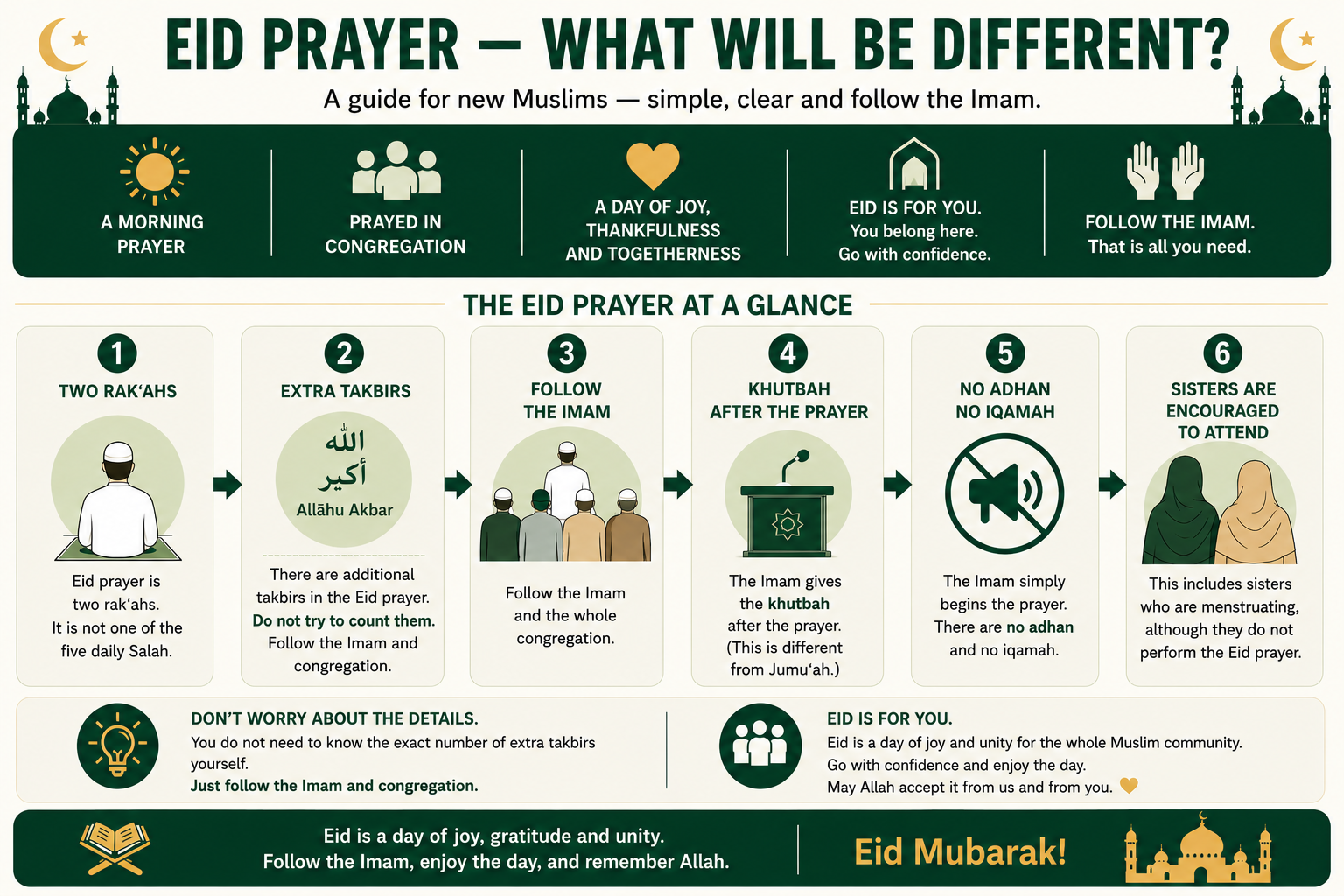
- It is two rak‘ahs.
- There are extra takbirs. A takbir is saying Allahu Akbar.
- The khutbah comes after the prayer. This is different from Jumu‘ah, where the khutbah comes before the prayer.
- There is no adhan or iqamah for the Eid prayer.
Authentic reports describe Prophet Muhammad ﷺ praying two rak‘ahs on Eid. Other reports describe the Eid prayer being offered before the khutbah, without an adhan or iqamah.
Sahih al-Bukhari 989; Sahih al-Bukhari 957–961.
What about all the extra takbirs?
This is usually the part that feels most unfamiliar to a new Muslim. There are additional takbirs in the Eid prayer, and recognised schools of Islamic law differ in some details of their number and placement.
You do not need to solve that difference while standing in the prayer. Follow the imam and congregation.
Authentic hadith include reports of seven takbirs in the first rak‘ah and five in the second. Other established legal schools teach a different arrangement. For a beginner praying behind an imam, the practical lesson is simple: follow the prayer being led.
Do sisters attend Eid?
Yes. Women were instructed to come to the Eid gathering. Authentic reports specifically include young women and menstruating women.
A sister who is menstruating does not perform the Eid Salah, but the Prophetic instruction included her in the Eid gathering while remaining apart from the prayer place.
Umm ‘Atiyyah رضي الله عنها reported that women were instructed to come out for Eid, including menstruating women, so they could be present for the good and the gathering of the Muslims, while menstruating women remained apart from the prayer place.
Sahih al-Bukhari 324; Sahih Muslim 890.
Practical note for sisters: Eid may be held in a masjid, hall, field or other large venue. Follow the arrangements at your local Eid gathering. If you are menstruating and are unsure where you should sit or stand during the prayer, ask the organisers.
Before Eid al-Fitr prayer
Prophet Muhammad ﷺ would eat before going out for the Eid al-Fitr prayer. Anas ibn Malik رضي الله عنه reported that he would eat dates, in an odd number.
Anas ibn Malik رضي الله عنه reported that Prophet Muhammad ﷺ did not go out on Eid al-Fitr until he had eaten dates, and that he ate them in an odd number.
Sahih al-Bukhari 953.
This is a Sunnah practice, not a reason to panic if your morning does not go perfectly. The important point for a new Muslim is also very simple: Eid al-Fitr is not a fasting day.
Zakat al-Fitr comes before the Eid al-Fitr prayer
Zakat al-Fitr is connected specifically with the end of Ramadan. Prophet Muhammad ﷺ instructed that it be given before people went out for the Eid prayer.
Ibn ‘Umar رضي الله عنهما reported that Prophet Muhammad ﷺ instructed that Zakat al-Fitr be given before people went out to the Eid prayer.
Sahih al-Bukhari 1503, 1509.
If this is your first Ramadan and you do not know how your local community handles Zakat al-Fitr, ask your masjid before Eid morning. The amount, collection process and questions about giving food or monetary value require more detailed guidance than this prayer page is intended to provide.
What about Eid al-Adha?
Eid al-Adha is connected with Hajj and the remembrance of Prophet Ibrahim عليه السلام and his obedience to Allah.
You may also hear about udhiyah or qurbani, the sacrifice associated with Eid al-Adha. You do not need to arrange a sacrifice in order to understand or attend the Eid prayer.
There are additional Sunnah practices and fiqh details connected with Eid al-Adha — including eating, takbir during Dhul-Hijjah, the sacrifice and the Days of Tashriq. Rather than loading all of those rules into a beginner prayer guide, this V2 page keeps the focus on what you need when you arrive for Salah.
The Eid takbir
You will hear Muslims saying Allahu Akbar frequently around Eid. This remembrance is called takbir.
There are recognised details concerning the timing and wording of the Eid takbir, especially around Eid al-Adha. For a brand-new Muslim, you do not need to master all of those schedules before your first Eid. Listen, learn and join as you become comfortable.
What can I say to people?
Eid Mubarak is a common greeting. It means, approximately, “Blessed Eid.”
You may also hear:
تَقَبَّلَ اللَّهُ مِنَّا وَمِنْكُمْ
Taqabbal Allahu minna wa minkum.
May Allah accept from us and from you.
Do not worry about saying everything perfectly. A warm “Eid Mubarak” is enough.
If this is your first Eid
Eid is for you too. You do not become less Muslim because you do not yet know the customs, do not have Muslim relatives, or have never attended an Eid prayer before.
At the same time, Eid can sometimes feel lonely for converts whose families are not Muslim. If you are worried about being alone, it can help to tell someone you trust at the masjid before Eid and ask whether there are community meals, convert gatherings or other activities you can join. We cannot promise what every community will provide, but you do not have to pretend that the day feels easy if it does not.
Your first Eid does not have to look like someone else's tenth Eid. Go to the prayer if you can, follow the imam, greet people, remember Allah and let yourself learn the day gradually.
Beginner summary
- There are two Eids: Eid al-Fitr and Eid al-Adha.
- The Eid prayer is two rak‘ahs.
- It contains extra takbirs.
- You do not need to count the extra takbirs yourself when praying behind an imam.
- The khutbah comes after the Eid prayer.
- There is no adhan or iqamah for the Eid prayer.
- Sisters are encouraged to attend; menstruating sisters do not perform the prayer.
- On Eid al-Fitr, Zakat al-Fitr is given before the prayer.
- Eid al-Fitr is not a fasting day.
- If this is your first Eid, follow the imam and congregation and learn one step at a time.
- Confirm the legal classification of Eid prayer across the madhhabs and the safest beginner wording.
- Confirm the number and placement of additional takbirs and how much madhhab detail belongs on this page.
- Confirm hand-raising guidance during the additional takbirs.
- Confirm the modern practical wording for menstruating sisters attending when Eid is held in a masjid, hall or field.
- Confirm any recommended ghusl, clothing and perfume guidance worth restoring from the old page.
- Confirm Eid al-Adha eating guidance and its legal classification.
- Confirm the Eid takbir formula and timing for Eid al-Fitr and Eid al-Adha.
- Confirm the Days of Tashriq fasting guidance and whether it belongs on this beginner page or a separate resource.
- Confirm post-obligatory-Salah takbir timing during Dhul-Hijjah/Tashriq and recognised madhhab differences.
- Confirm udhiyah/qurbani timing and whether that material should be taught elsewhere.
- Confirm the status and preferred wording of “Taqabbal Allahu minna wa minkum” as an Eid greeting.