

You may be at the masjid when someone announces that a janazah will be prayed. People form rows, remain standing, and follow the imam through a short prayer with four takbirs.
If you have never seen it before, it can feel unfamiliar because there is no bowing and no prostration. You do not need to have known the person who died in order to join the prayer.
New Muslim? Do not panic if you do not know every word yet. Stand with the congregation, watch the people around you, and follow the imam. This page will show you what is happening.
What is the Janazah prayer?
Salat al-Janazah is the funeral prayer for a Muslim who has died. It is offered before burial, usually in congregation.
It is a fard kifayah — a communal obligation. That means the Muslim community must ensure that the funeral prayer is performed, although every individual Muslim is not required to attend every janazah.
Prophet Muhammad ﷺ taught that the person who remains for the funeral prayer receives one qirat of reward, and the person who remains through the burial receives two qirats, described as being like two enormous mountains.
Sahih Muslim 945a. See also Sahih al-Bukhari 1325.
The first thing to remember
- You remain standing throughout the prayer.
- There is no ruku‘ (bowing).
- There is no sujud (prostration).
- There is no adhan or iqamah for Janazah.
- Follow the imam. He will say the takbirs aloud so the congregation knows when to move to the next part.
The normal beginner structure you will encounter is four takbirs. Authentic reports describe Prophet Muhammad ﷺ offering Janazah with four takbirs.
The companions reported that Prophet Muhammad ﷺ formed the people into rows for a funeral prayer and said four takbirs.
Sahih al-Bukhari 1319, 1333 and 1334.
Janazah Prayer — Beginner Guide
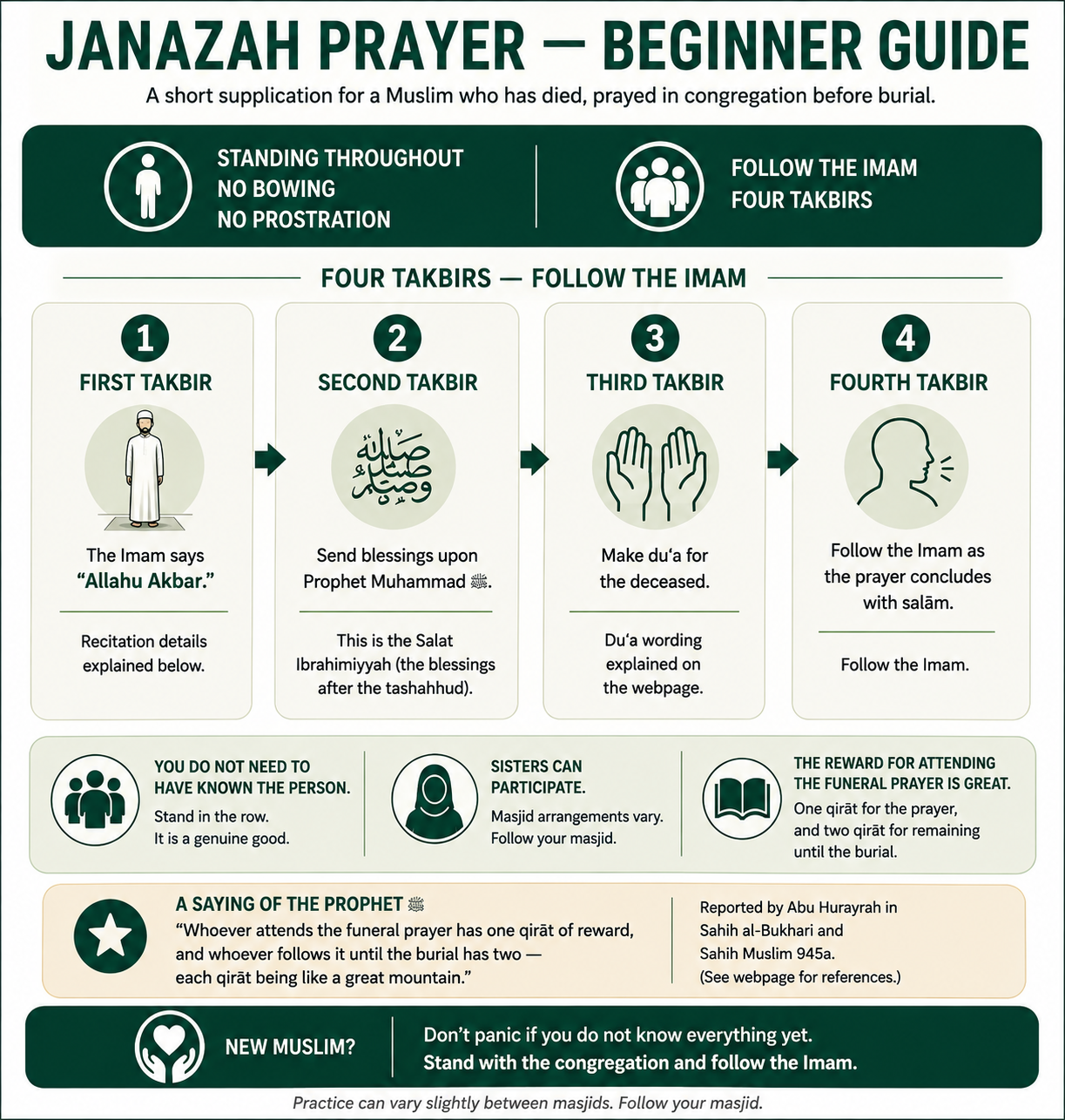
What happens at each takbir?
1. First takbir
The imam says Allahu Akbar. Follow the imam and remain standing.
A well-known authentic report states that Ibn ‘Abbas رضي الله عنهما recited Al-Fatihah in a funeral prayer and explained that doing so was from the Sunnah. There are recognised differences among the schools of Islamic law concerning the recitation at this point, so the final V2 wording will be confirmed during scholar review.
Ibn ‘Abbas رضي الله عنهما recited Al-Fatihah during a funeral prayer and said that people should know that it was from the Sunnah.
Sahih al-Bukhari 1335.
If you are brand new: stay with the congregation and follow the imam. Do not leave the prayer because you are still learning what to recite. The exact accommodation for a new Muslim who cannot yet recite the required Arabic is flagged for scholar review.
2. Second takbir
The imam says Allahu Akbar again. The congregation sends blessings upon Prophet Muhammad ﷺ.
If you have learned the Salat Ibrahimiyyah from your regular Salah, these are the blessings referred to here.
If you are still learning the words used in regular Salah, see Prayer Memorization Guide.
3. Third takbir
The imam says Allahu Akbar a third time. This is the part of the prayer in which du‘a is made for the Muslim who has died.
One authentic du‘a reported from Prophet Muhammad ﷺ begins:
اللَّهُمَّ اغْفِرْ لَهُ وَارْحَمْهُ، وَعَافِهِ وَاعْفُ عَنْهُ، وَأَكْرِمْ نُزُلَهُ، وَوَسِّعْ مُدْخَلَهُ، وَاغْسِلْهُ بِالْمَاءِ وَالثَّلْجِ وَالْبَرَدِ، وَنَقِّهِ مِنَ الْخَطَايَا كَمَا نَقَّيْتَ الثَّوْبَ الْأَبْيَضَ مِنَ الدَّنَسِ، وَأَبْدِلْهُ دَارًا خَيْرًا مِنْ دَارِهِ، وَأَهْلًا خَيْرًا مِنْ أَهْلِهِ، وَزَوْجًا خَيْرًا مِنْ زَوْجِهِ، وَأَدْخِلْهُ الْجَنَّةَ، وَأَعِذْهُ مِنْ عَذَابِ الْقَبْرِ وَعَذَابِ النَّارِ
Allahummaghfir lahu warhamhu, wa ‘afihi wa‘fu ‘anhu, wa akrim nuzulahu, wa wassi‘ mudkhalahu, waghsilhu bil-ma’i wath-thalji wal-baradi, wa naqqihi minal-khataya kama naqqaytath-thawbal-abyada minad-danasi, wa abdilhu daran khayran min darihi, wa ahlan khayran min ahlihi, wa zawjan khayran min zawjihi, wa adkhilhul-jannata, wa a‘idhhu min ‘adhabil-qabri wa ‘adhabin-nar.
O Allah, forgive him and have mercy on him, grant him wellbeing and pardon him, honour his reception and make his entrance spacious. Wash him with water, snow and hail, and cleanse him of sins as a white garment is cleansed of stains. Give him a home better than his home, a family better than his family and a spouse better than his spouse. Admit him into Paradise and protect him from the punishment of the grave and the punishment of the Fire.
Reported in Sahih Muslim 963a–d.
If the deceased is a woman: the Arabic pronouns in this du‘a change. Do not worry about mastering those changes on your first day. Learn with your imam or teacher.
4. Fourth takbir
The imam says Allahu Akbar again. Continue following him as the prayer concludes with salam.
You may encounter slightly different practice concerning the salam and some other details of Janazah. As a beginner praying behind an imam, you do not need to solve those differences during the prayer — simply follow your imam.
Do sisters participate?
Yes. Sisters can participate in the Janazah prayer. The physical arrangement varies between masjids, so follow the congregation and the instructions at your local masjid.
Questions about following the funeral to the cemetery are separate from the question of praying Janazah itself and involve fiqh details that will be reviewed by the scholar.
Where is the deceased during the prayer?
The deceased is placed in front of the imam while the congregation forms rows behind him. The exact physical arrangements can differ depending on the masjid, funeral facility, cemetery and local requirements.
You do not need to know details about caskets, viewing arrangements or funeral-home procedures in order to join the Janazah prayer. Those are not part of the four-takbir prayer procedure itself.
Local arrangements vary. If you are attending a Janazah and are unsure where to stand or where sisters should go, ask someone at the masjid. Nobody expects a new Muslim to know the building's funeral arrangements automatically.
When you hear that someone has died
Muslims often say:
إِنَّا لِلَّهِ وَإِنَّا إِلَيْهِ رَاجِعُونَ
Inna lillahi wa inna ilayhi raji‘un.
Indeed, we belong to Allah, and indeed to Him we will return.
Qur'an 2:156.
You may hear this when someone dies, but the Qur'anic phrase is broader than death alone: it is said when believers are struck by a calamity.
What happens before and after Janazah?
The Janazah prayer is one part of the Muslim funeral process. The deceased is prepared for burial, the funeral prayer is offered, and burial follows. The details of washing, shrouding, transporting and burying the deceased deserve their own careful teaching and can also be affected by local legal and cemetery requirements.
This page therefore focuses on the part a new Muslim is most likely to encounter unexpectedly: how to stand with the congregation and understand the Janazah prayer.
If someone in your non-Muslim family dies
For many converts, this is not an abstract question. A parent, grandparent, spouse or other person you love may not be Muslim.
The rulings concerning attending a non-Muslim funeral, participating in religious portions of another faith's service, burial responsibilities and making particular forms of du‘a for someone who died outside Islam need careful explanation. They should not be reduced to a few frightening sentences on a beginner funeral-prayer page.
Please speak with a trusted imam before you need this guidance if you can. You can ask specifically what you may attend, what family responsibilities you may fulfil, which parts of a religious service you should not participate in, and what du‘as you may make.
Your grief is real. Becoming Muslim does not require you to stop loving your parents or relatives. If you face this situation, seek knowledgeable guidance and compassionate support rather than trying to work through a sensitive ruling alone in the middle of bereavement.
Beginner summary
- Janazah is the Muslim funeral prayer.
- It is a communal obligation.
- You remain standing throughout.
- There is no bowing and no prostration.
- The normal beginner structure is four takbirs.
- Follow the imam.
- The prayer includes blessings upon Prophet Muhammad ﷺ and du‘a for the deceased.
- You do not need to have personally known the deceased in order to participate.
- Sisters can participate in the Janazah prayer.
- If you are new and do not know every recitation yet, do not panic. Keep learning.
- Confirm beginner wording for fard kifayah and any qualification required.
- Confirm first-takbir recitation wording, including Al-Fatihah and recognised madhhab differences.
- Confirm hand-raising guidance at the first and subsequent takbirs.
- Confirm the preferred wording for Salat Ibrahimiyyah after the second takbir.
- Confirm the Janazah du‘a presentation, including male/female pronoun guidance.
- Give a practical ruling for a new Muslim who cannot yet recite the required Arabic.
- Confirm fourth-takbir and salam guidance, including one-versus-two-salam differences.
- Confirm any guidance needed on the imam's position relative to a male or female deceased.
- Confirm women's participation and the separate question of following the funeral to the cemetery.
- Review any funeral/burial information retained so local custom is not confused with universal Islamic law.
- Provide/approve pastoral beginner guidance concerning a non-Muslim relative's funeral and du‘a for a deceased non-Muslim.