

Core Lesson 20 — Beginning With the Qur'an
Choosing Your First Qur'an
You may walk into an Islamic bookshop, search online, or visit a masjid and suddenly discover that there seem to be dozens of different Qur'an editions.
Arabic only. Arabic with English. Different English translations. Transliteration. Colour-coded tajweed. Large print. Small print. Complete Qur'ans. Smaller learning books.
Why do Qur'an books look different?
Different-looking Qur'an editions do not mean that Muslims have different revised Qur'ans. The books may use different print sizes, page layouts, styles of Arabic writing, translations or learning aids such as transliteration and tajweed colouring.
An English translation gives you the meanings of the Qur'an in English. The Qur'an itself was revealed in Arabic.
You do not need to understand all of those choices before you begin.
If someone has already given you a Qur'an, you probably do not need to replace it. Begin with what you have. This lesson will simply help you understand some of the choices you may see.
First: the Qur'an was revealed in Arabic
The Qur'an is the revelation Allah gave to Prophet Muhammad ﷺ in Arabic.
If you do not understand Arabic yet, an English translation of the meanings of the Qur'an helps you begin understanding what Allah revealed.
Different translators sometimes choose different English words to express the meaning of the same Arabic verse. That is why two English translations may sound slightly different.
You do not need to know Arabic before you begin reading and learning from the Qur'an.
What should a beginner look for?
There is no single edition that every new Muslim must buy.
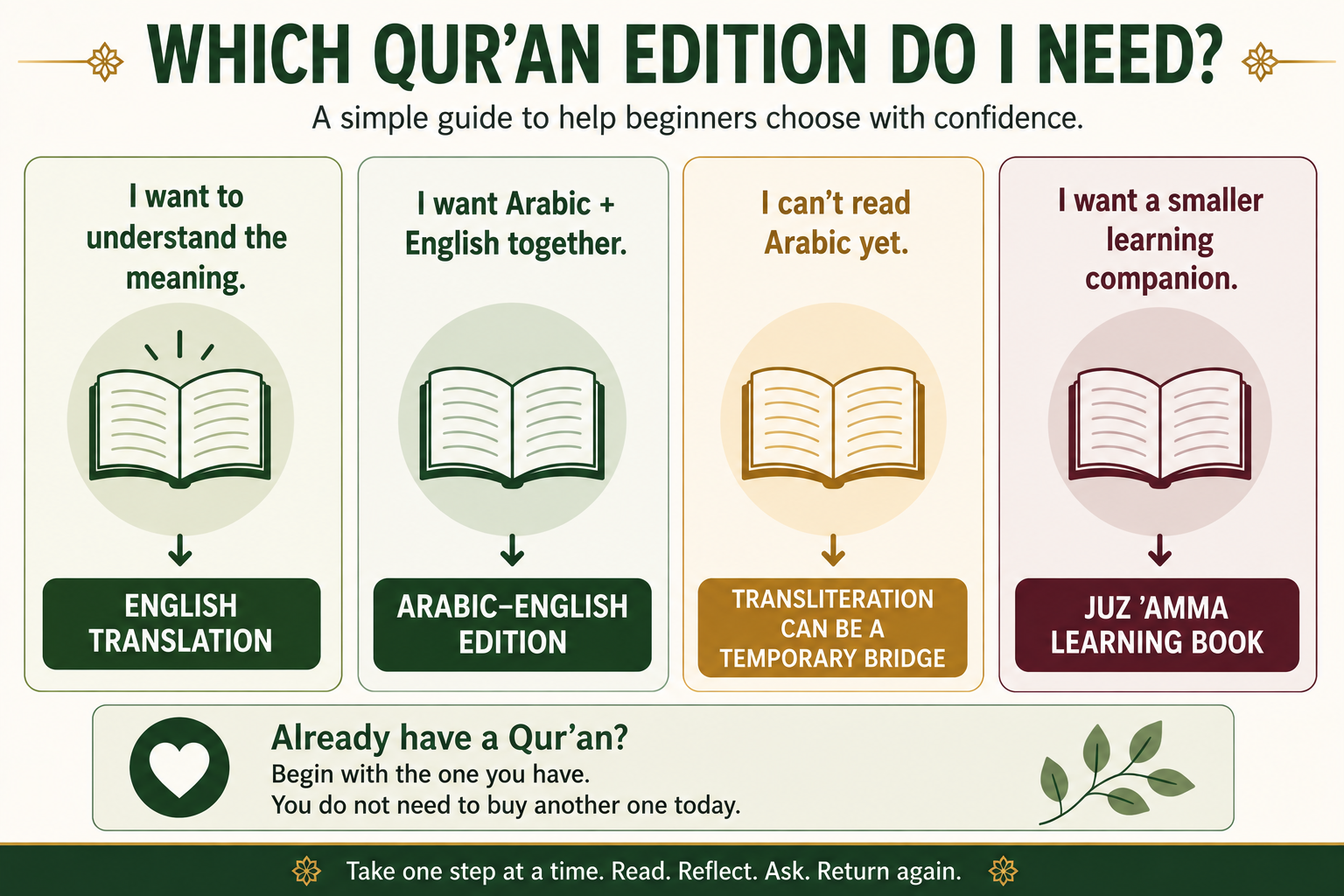
Depending on what you need right now, you might choose:
- Arabic with English translation — helpful if you want to see the Arabic and read the meaning together.
- An English translation — helpful for reading and understanding the meaning comfortably.
- Arabic, transliteration, and English together — helpful temporarily while you are learning how Arabic words sound.
- A Juz 'Amma learning book — helpful if you want a smaller book containing many of the short surahs beginners often learn early.
You may eventually use more than one of these.
You do not have to choose your lifetime Qur'an today.
What is Juz 'Amma?
The Qur'an is divided into thirty sections. One section is called a juz.
Juz 'Amma is the thirtieth and final juz of the Qur'an. It contains many short surahs.
A surah is a chapter of the Qur'an.
Many of the shorter surahs that beginners learn are found in Juz 'Amma, which is why you may see it sold separately as a small learning book.
You do not need to buy it separately. The same surahs are already inside a complete Qur'an.
Already own a complete Qur'an? Keep using it. A separate Juz 'Amma book is simply a convenient option, not something you must buy.
What is transliteration?
Transliteration writes the sounds of Arabic words using Roman letters — the alphabet used for English.
It can help you follow along before you are able to read Arabic script.
But transliteration has an important limitation: English letters cannot represent every Arabic sound accurately.
Think of transliteration as a temporary bridge, not the final destination.
Listen carefully to correct recitation while you use it, and gradually learn the Arabic letters themselves.
What is colour-coded tajweed?
Tajweed is the study of how the Qur'an is recited correctly.
Some Qur'an editions use different colours to mark places where particular tajweed rules apply.
This can help you notice those places as you learn, but the colours cannot teach you how to pronounce every sound correctly by themselves.
Listening to a skilled reciter and eventually having a knowledgeable person listen to your recitation are important parts of learning too.
We will introduce tajweed properly in Lesson 23.
Which English translation should I choose?
There are many English translations of the meanings of the Qur'an. You do not need to compare all of them before you begin.
One translation that many English-speaking readers find approachable is:
The Qur'an — translated by M. A. S. Abdel Haleem
Its English is generally flowing and contemporary, which can make it comfortable for sustained reading.
You may also encounter Saheeh International, which is widely available and uses a different English style.
If you already own another translation, do not assume that you need to replace it simply because its name is not listed here.
As you learn more, you may sometimes compare translations or ask a knowledgeable teacher about a verse that is difficult to understand.
Why can translations sound different? The Arabic Qur'an has not changed. Translators sometimes make different choices about how best to express an Arabic word or sentence in English.
You can begin before buying anything
If you do not own a Qur'an yet, that does not need to stop you from beginning.
Digital Qur'an tools can help you:
- see the Arabic text;
- read an English translation;
- listen to Qur'an recitation;
- repeat a short passage while learning it; and
- sometimes follow transliteration while learning Arabic script.
These tools can be very useful, but an app cannot always tell whether you are pronouncing an Arabic sound correctly.
When you are able, let a knowledgeable teacher or competent Qur'an reader listen to you recite.
Where should I begin reading?
You have more than one good way to begin.
You can start at the beginning of the Qur'an with Al-Fatihah and continue from there.
You can also spend some of your learning time with the shorter surahs near the end of the Qur'an, especially as you begin learning Qur'an for salah.
You do not need to race through pages.
Read a manageable amount. Read the meaning. Think about what you have read. Ask questions when you do not understand something. Then return again.
Islam is now your whole life, but you do not need to learn your whole religion today.
A few verses read carefully are a real beginning.
A new word you may hear: tafsir
Tafsir means explanation or commentary on the Qur'an.
A tafsir may explain Arabic words, the context of a passage, connections between verses, and how Muslim scholars have understood them.
You do not need to buy a large collection of tafsir books as you begin.
But if a verse is difficult to understand, a trustworthy explanation or knowledgeable teacher can be very helpful.
Treat the Qur'an with respect
Muslims treat the Qur'an with honour and respect because it contains the revelation Allah gave to Prophet Muhammad ﷺ.
You may hear Muslims discuss particular etiquettes and rulings concerning physical copies of the Arabic Qur'an, including questions about ritual purity.
Some of those questions need more explanation than belongs in a lesson about choosing your first Qur'an.
For now, handle the Qur'an respectfully and keep learning. When a specific question arises, ask a knowledgeable teacher.
So what should I buy?
A simple beginner answer: choose something you are comfortable opening and actually using.
- If you mainly want to understand what you are reading, a clear English translation can be a good beginning.
- If you want to see the Arabic and English together, choose an Arabic-English edition.
- If you cannot read Arabic yet, transliteration may be useful as a temporary learning aid.
- If a large book feels overwhelming, a Juz 'Amma learning book can be a convenient smaller companion.
And if you already have a Qur'an?
Begin with the one you have.
You can learn about other editions later.
What comes next
Now that you understand some of the Qur'an editions and learning tools you may encounter, the next step is simply learning how to begin reading.
In the next lesson, we will look at a manageable way to start reading the Qur'an as a new Muslim.
Next: How to Begin Reading the Qur'an →