

Your first visit to a masjid can feel like walking into a place where everyone else already knows the routine.
Where do you enter? Where do your shoes go? What if the brothers and sisters pray in different areas? What if you cannot see the Imam? Why can you hear some prayers but not others?
You are not expected to know what nobody has taught you.
This lesson will help you understand what you may see and hear so that your first visits feel less confusing.
What is a masjid?
Masjid is the Arabic word commonly used for a Muslim place of worship. In English, you will also hear the word mosque.
Muslims gather at masjids for Salah, the Friday Jumu'ah prayer, Qur'an learning, classes, community activities and other forms of worship and service.
Masjids do not all look or operate exactly the same way. One may be a large purpose-built centre with signs and several entrances. Another may be a converted building with a small prayer room and very little signage.
If you walk in and do not know where to go, ask. “Assalamu alaykum, I'm new. Could you show me where the prayer area is?” is enough.
Do you have to be Muslim to enter a masjid?
No. A person does not need to be Muslim simply to visit a masjid.
A non-Muslim relative, friend or guest may often be able to visit as well, although local masjids may have their own arrangements for visitors, events or particular spaces.
If you would like to bring someone with you, contacting the masjid ahead of time can make the visit easier.
When you arrive
The first few minutes may involve several unfamiliar things at once.
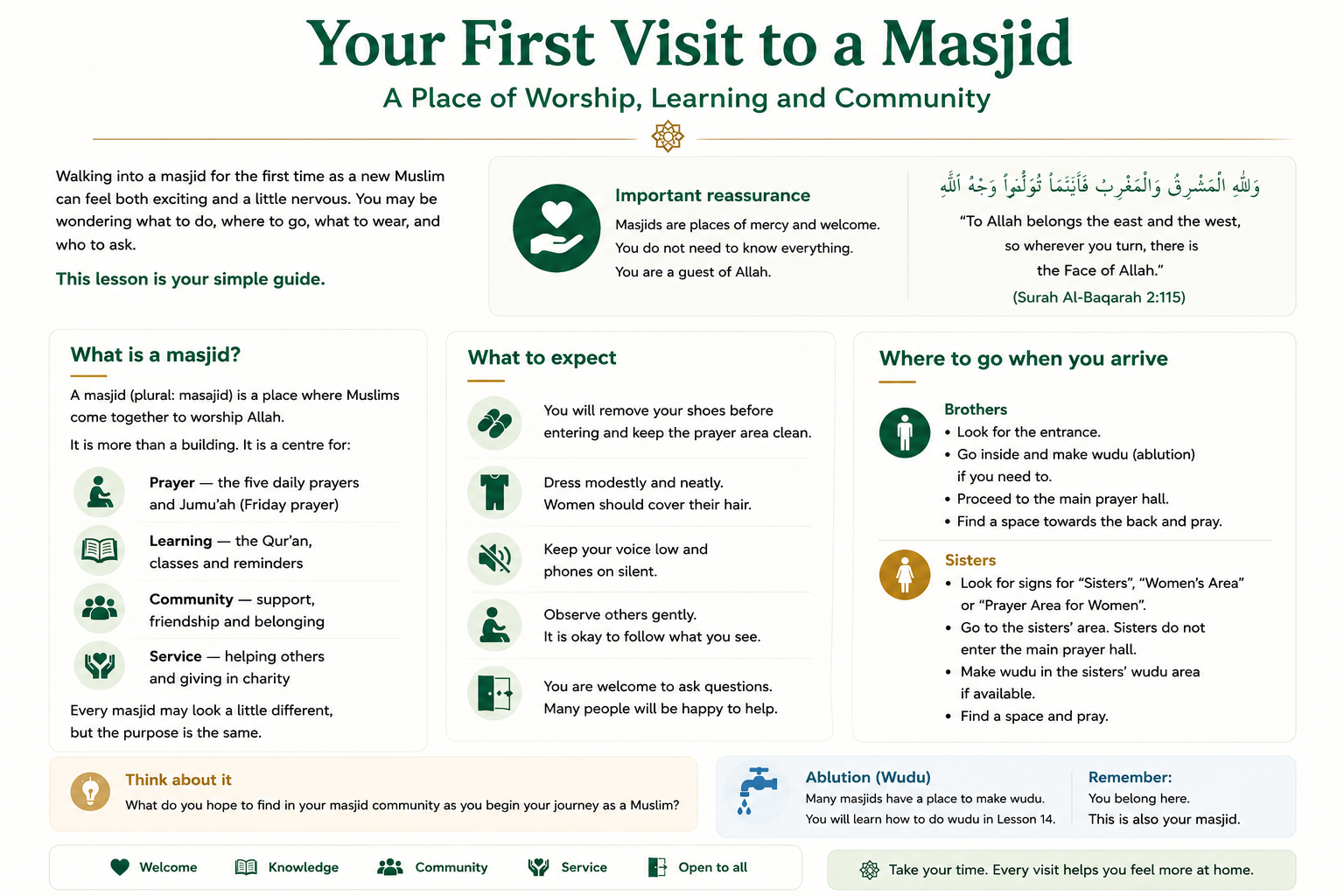
- Look for the correct entrance. Some masjids use the same entrance for everyone. Others have separate entrances or routes for brothers and sisters.
- Ask if the layout is unclear. The sisters' prayer area may be upstairs, downstairs, behind a partition or in another room.
- Look for the shoe area. Shoes are normally removed before entering the carpeted prayer space. Shoe racks are often near the entrance.
- Wear respectful, modest clothing. You do not need to arrive already knowing every detail of Islamic dress to visit and learn.
- Silence or lower your phone. People may already be praying, reciting Qur'an or making dhikr.
If you are unsure whether a particular doorway, room or area is for you, asking is completely normal.
A simple masjid orientation
Masjid layouts vary. This is an orientation guide, not a floor plan for every masjid.
Before you sit down — Tahiyyat al-Masjid
When you enter the masjid's prayer area, you may see people pray two rak'ahs before sitting down. This is called Tahiyyat al-Masjid — the greeting of the masjid.
If you already know how to pray Salah, you do not need to learn a completely new prayer. It is a two-rak'ah prayer using the same basic prayer sequence.
Still learning Salah? Do not feel that you cannot enter the masjid because you have not learned the prayer yet. You are welcome to come, learn and ask for help. Later, Lesson 17 — How to Pray — Step by Step teaches the prayer sequence, and the Prayer Memorization Guide helps you learn what to say.
If your first visit is for Friday Jumu'ah, Lesson 19 — Jumu'ah — Friday Prayer explains the Friday-specific flow, including what to do if the khutbah has already begun.
What if I need wudu?
You may see a wudu area with taps, low sinks, stools or other facilities designed for washing before prayer.
Do not worry if you do not yet know how to use it or whether you need wudu in a particular situation.
The next part of New To Islam is about Purity. You will learn what ritual purity means, when ghusl applies, how to make wudu and when tayammum may be used.
The sisters' prayer area may feel very different
If you are a woman, this is especially important to know before your first congregational prayer.
In some masjids, the sisters pray in the same large hall behind the men's rows. In others, the sisters may be behind a partition, on another floor or in a separate room.
You may not be able to see the Imam at all.
That does not necessarily mean you are disconnected from the congregational prayer. In many masjids, sisters in a separate prayer space follow the Imam by hearing him through speakers.
If you cannot see the Imam, listen. The sounds you hear are part of how the congregation knows when to move from one prayer position to the next.
If you cannot see the Imam
from the main prayer area
through the masjid speakers
with the congregation
You do not need a direct view of the Imam to understand that the congregation is moving with his audible cues.
Why can I hear Qur'an in some prayers but not others?
This surprises many beginners.
In the five daily prayers, the Imam's Qur'an recitation is audible in some rak'ahs and quiet in others.
A quiet prayer does not mean the sound system is broken, the Imam has stopped praying or you have missed something.
Five-prayer sound guide
This shows whether the Imam's Qur'an recitation is normally audible or quiet in each rak'ah of the obligatory congregational prayer.
| Prayer | 1 | 2 | 3 | 4 |
|---|---|---|---|---|
| Fajr | Audible | Audible | — | — |
| Dhuhr | Quiet | Quiet | Quiet | Quiet |
| Asr | Quiet | Quiet | Quiet | Quiet |
| Maghrib | Audible | Audible | Quiet | — |
| Isha | Audible | Audible | Quiet | Quiet |
“Quiet” describes the Qur'an recitation. The Imam still normally gives audible cues for the congregation's movements.
Quiet here refers to the Qur'an recitation. It does not mean the Imam makes no audible sound at all.
So how do I know when to move?
During congregational Salah, the congregation follows the Imam.
The Imam normally gives audible cues as the prayer moves from one position to another.
You will often hear:
Allahu Akbar — “Allah is the Greatest.”
This phrase is called a takbir. In congregational prayer, you will hear it at many of the transitions between prayer positions.
But there is one important exception a beginner should know now:
When the Imam rises from ruku' — the bowing position — he says:
Sami' Allahu liman hamidah
Meaning: Allah hears the one who praises Him.
So do not expect every movement in the prayer to be announced with Allahu Akbar.
You will learn the words you say during Salah later. For now, the important idea is simple:
Follow the Imam. Do not move ahead of him. If you cannot see him, listen for the prayer cues and follow the congregation.
What positions will I see?
You do not need to learn the entire prayer sequence in this lesson. Lesson 17 will teach Salah step by step.
For now, recognize these basic positions:
- Qiyam — standing.
- Ruku' — bowing.
- Standing after ruku' — returning upright after bowing.
- Sujood — prostration, with the forehead lowered to the ground.
- Sitting — sitting between or after parts of the prayer.
If you are praying with the congregation, you follow the Imam through these movements rather than setting your own pace.
Where do I stand?
Congregational prayer is performed in rows, with worshippers facing the qiblah.
The qiblah is the direction of the Ka'bah in Makkah.
Inside a masjid, the prayer space is already arranged toward the qiblah, so you normally do not need to calculate the direction yourself.
If people are forming rows and you are uncertain where you belong, quietly ask someone nearby or stand beside an experienced worshipper who can help you.
You do not need to know every detail about rows on your first visit. Join the congregation, follow the people around you and keep learning.
What are the mihrab and minbar?
You may hear two unfamiliar words when people describe the front of a masjid:
- Mihrab — an architectural feature or marked area at the front that helps identify the qiblah direction.
- Minbar — the pulpit or raised place used for the Friday khutbah and other addresses.
You do not need to memorize these words before visiting. They will become familiar with time.
What if I arrive after the prayer has started?
Do not panic.
Enter quietly, join the congregation and follow the Imam from the position the congregation is currently in.
There are detailed rules about what to do when you have missed part of a congregational prayer. You do not need all of that fiqh in your first masjid-orientation lesson.
If this happens before you have learned those rules, ask a knowledgeable person at the masjid to help you.
What happens after the prayer?
The ending may also feel confusing because not everyone necessarily does exactly the same thing at the same moment.
After the obligatory prayer, some people may remain seated for dhikr or du'a. Some may pray additional prayers. Some may greet people. Others may leave fairly quickly.
Do not assume you are doing something wrong simply because another person stays longer or leaves sooner.
You will learn the different acts of worship around Salah gradually.
What is different on Friday?
Friday's Jumu'ah gathering is different from an ordinary Dhuhr prayer.
A khutbah — a sermon or formal address — comes before the congregational prayer.
Jumu'ah has its own rulings and etiquette, so we will give it a dedicated lesson later rather than squeezing all of those details into your first masjid visit.
Simple masjid etiquette
You do not need a long rulebook before you walk through the door. Start with a few simple habits:
- Come in clean clothing and treat the prayer space respectfully.
- Dress modestly.
- Remove shoes where the masjid requires them to be removed.
- Keep your voice reasonable, especially when people are praying.
- Avoid walking directly in front of someone who is praying where possible.
- Ask before photographing or recording people.
- Follow local arrangements for children, family spaces, classes and community events.
Local masjids may have additional practical guidelines. Those arrangements can vary without changing the basic purpose of the masjid.
What if everyone seems to know more than I do?
You may look around and think:
“Everyone knows what to do except me.”
Remember what is actually happening: many people around you have repeated these actions for years. You are seeing the result of practice, not proof that you should already know everything.
It is okay to watch.
It is okay to ask.
It is okay to stand beside someone experienced.
It is okay to make beginner mistakes.
Islam is now your whole life, but you do not need to learn your whole religion today.
Ten words to recognize
- Masjid — a Muslim place of worship; mosque.
- Imam — here, the person leading the congregational prayer.
- Salah — the formal Islamic prayer.
- Rak'ah — one unit of Salah.
- Qiblah — the direction of the Ka'bah in Makkah.
- Takbir — saying Allahu Akbar.
- Qiyam — standing in prayer.
- Ruku' — bowing in prayer.
- Sujood — prostration.
- Jumu'ah — the Friday congregational prayer and gathering.
Your next step
For your first masjid visits, remember this:
You do not need to understand the entire building, know every Arabic word or copy everyone perfectly. Find the prayer area, ask when you are unsure, follow the congregation, and keep learning.
You have now completed Part 1 — Beginning Your Journey.
Next, we begin one of the practical foundations you will need for Salah:
Purity.
Continue to Part 2 — Purity